





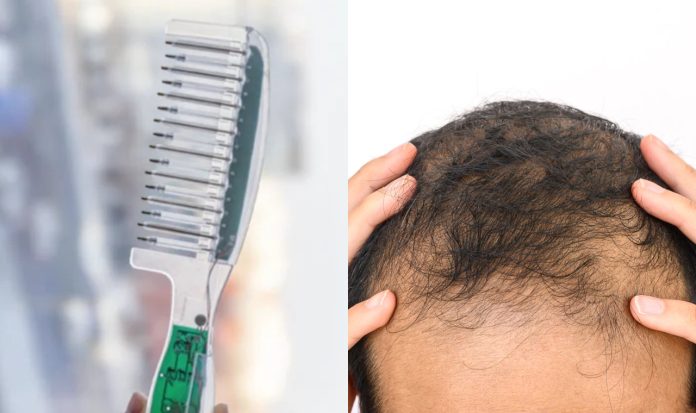
Baldness is among the main problems troubling crores of people worldwide, and for male-pattern baldness, common among men, there has so far been no complete, permanent solution. Scientists from China have now announced an invention aimed at tackling the problem: a special electric comb that rapidly regrows lost hair simply through combing. Called “Detangle,” the device has shown results close to 100 percent in preventing baldness in tests, the researchers have said.
The research was carried out by a team of scientists from Beihang University in Beijing, and full details of the study were published this month in the international science journal Nature Communications. The scientists said the Detangle comb works much faster and more effectively than the medicines and treatments currently used to stop hair loss. Although the device is still at the experimental stage, excellent results in tests on mice have raised hopes.
Unlike ordinary combs, its teeth carry electrodes of varying heights and special molecules that carry medicine. When the hair is combed, the device generates a gentle electric field around the hair follicles in the scalp. This electrical stimulation excites the follicles, while the drug molecules reach deep into the skin directly. As a result, dormant follicles become active again, helping new hair grow quickly.
Minoxidil is the drug most widely used worldwide in baldness treatment, and the researchers showed that the Detangle comb delivered many times better results. In a month-long test on mice with baldness, ordinary minoxidil treatment regrew only 70 percent of the hair, while the electric comb regrew hair close to 100 percent, the scientists said.
Nearly 80 percent of men worldwide face baldness at some stage of their lives, and it causes not only physical change but also low self-esteem and mental stress in many. Existing treatments have limitations: minoxidil takes up to a year to show results, must be used for life and can cause scalp itching and headaches, finasteride carries the risk of serious side effects such as reduced sexual function and depression, and hair transplant surgery is expensive and painful. Experts caution that the new technology has so far been tested only on mice and there is no official evidence yet on how well it will work in humans.
The researchers hope the success in animal experiments will serve as a benchmark, though more safety tests will be needed before clinical trials on humans can begin, and the comb will be made available to the public only once it is confirmed to be fully safe and effective for humans.