





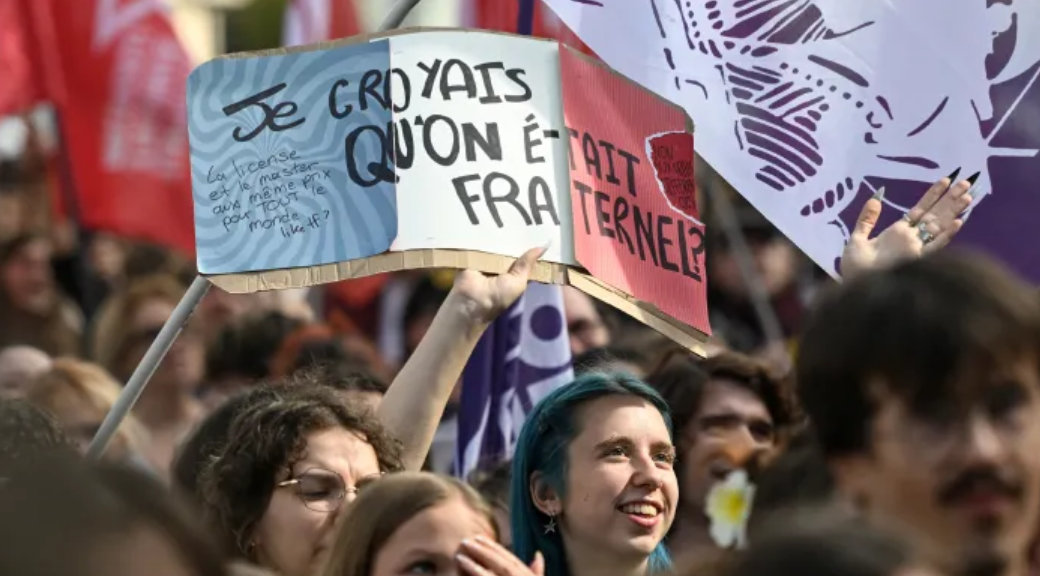
Paris: Protests over crowded classrooms, teacher shortages and lengthy school days have spread across France, with police detaining more than 400 people, many of them minors, on Tuesday. The movement began at high schools in the Paris area last week before expanding nationwide, and the education ministry says about 400 of the country’s 3,700 lycees have been affected. Some blockades turned violent, with protesters burning rubbish bins and hurling bottles, paving stones and other projectiles at officers, who responded with batons and tear gas. Authorities said 48 law enforcement officers were injured.
Confrontations were reported in Lille, Bordeaux, Rennes, Nantes, Lyon and Marseille, and tear gas was used in some places after bus shelters and advertising hoardings were vandalised. About 80 students gathered outside the Lamartine school in Paris with placards complaining of getting more hours of lessons than sleep, while roughly 100 students threw projectiles at the Lycee Brequigny in Rennes. Interior Minister Laurent Nunez said 440 people had been detained nationwide, though the tally was not final, and about two-thirds were placed in police custody. He condemned protesters who arrived with covered faces and projectiles, and reported seven incidents in which hydrochloric acid was thrown at police.
Students cite large classes of up to 32 to 35 pupils, absent teachers, inadequate school buildings and exhausting schedules. Vincent Latour, professor of British studies at Universite Toulouse Jean Jaures, said discontent has been building since June’s heatwaves exposed poorly insulated schools without air conditioning, and that the number of secondary schools involved has doubled in recent days. Saint-Denis Mayor Bally Bagayoko joined hundreds of students outside the Paul-Eluard lycee, calling the protest “completely legitimate” and saying poorer areas receive fewer resources. Ryad Rani, president of the Union Syndicale Lyceenne, criticised the government’s response as institutionalised repression while urging protesters to remain peaceful.
The unrest coincided with a nationwide public-sector strike against the government’s proposed budget, which includes 54 billion euros in funding cuts and savings. The government also plans to freeze state employees’ base salaries in 2027 to save about 2 billion euros, which unions say would be the fourth consecutive annual freeze. Teachers, firefighters and other public sector workers joined Tuesday’s action, with the education ministry saying just over 11 percent of teachers and school staff took part. Caroline Cheve of the FSU education union federation said pupils and teachers share the same frustrations over overcrowded classrooms and staffing shortages.
The protests have sharpened political tensions ahead of next spring’s presidential election, adding to the challenges facing President Emmanuel Macron. Prime Minister Sebastien Lecornu condemned the violence, saying nothing justifies endangering students, staff or police, and accused opponents of exploiting the students’ anger for partisan purposes. Jean-Luc Melenchon of the France Unbowed party accused the government of ordering a crackdown on students, describing the brutality as having a clear racist undertone, which Lecornu rejected as an insult. With Lecornu seeking support for the 2027 budget in a divided parliament, Latour said the political climate is explosive amid wider anger over public services, high fuel prices and pressure on household finances.