





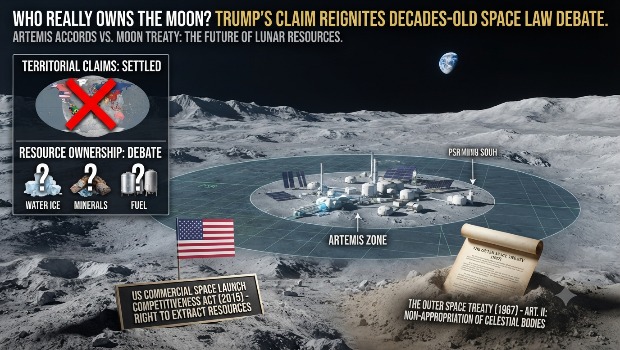
If someone were asked who owns the Moon, the common answer would likely be that it belongs to all of humanity. US President Donald Trump, however, appears to see it differently. Earlier this month, Trump posted a picture of the Moon on his social media platform, Truth Social, captioned “The Moon is Ours.” The claim raises a pointed question: can any country genuinely lay claim to the Moon? Can the United States assert control over it? And if the Moon belongs to no one, who owns the water, ice, and minerals found on it? The answers lie in international space law — and while the legal position on lunar territory is fairly settled, the picture surrounding lunar resources remains far less clear.
The answer to the territorial question traces back to a nearly 60-year-old international agreement. In 1967, numerous countries signed the Outer Space Treaty, which clearly states that the Moon and other celestial bodies cannot become the property of any single nation. In practical terms, this means the US planting a flag on the Moon, constructing a building there, or setting up a base does not make lunar territory American. Likewise, China, Russia, India, or any other nation cannot claim any part of the Moon as its own territory — reaching the Moon and owning it are two entirely different matters. Trump’s statement is therefore best understood as a political remark made on social media rather than a formal declaration of ownership under international law, which remains unambiguous on this point.
The harder question begins where territorial law ends: if no one owns the lunar soil, who owns the water, ice, or minerals extracted from it — a question long debated among experts worldwide. In the future, the most valuable commodity on the Moon may not be gold or silver, but water ice. Scientists believe certain permanently shadowed regions of the Moon may hold reserves of it, which, if extracted, could be used to produce water, with oxygen drawn from that water and hydrogen used for rocket fuel — making lunar water potentially critical for future human habitation and space travel. Various minerals and metals in lunar soil could similarly be used to construct homes, laboratories, and other facilities on the Moon in the future.
The United States has already enacted domestic legislation on this front. A 2015 law grants American citizens and companies the right to extract and utilise resources from space, while Washington maintains this does not amount to a claim of ownership over the Moon or any other celestial body — its position holds that extracting resources from the Moon is not the same as claiming its land, a distinction that lies at the heart of the international debate. Were an American company to extract, say, 100 tons of water ice from the Moon in the future, one view holds that resources extracted in compliance with international law could be legitimately used; another raises the concern that large corporations gaining control over the Moon’s most valuable regions would run contrary to the very spirit in which it was designated as belonging to all of humanity.
NASA is already preparing to use lunar resources for future Moon missions and has begun working with private companies on projects to collect soil and other materials from the lunar surface, with an eye not just toward scientific knowledge but toward meeting the future needs of both humans and spacecraft operating there — a shift that could see the Moon’s resources carry growing economic value. In 2020, the US and several other countries launched the Artemis Accords, aimed at establishing common rules for the peaceful and safe exploration of the Moon and other celestial bodies, including Mars in the future. The accords affirm that no country can claim ownership of the Moon while acknowledging the extraction and use of water, ice, and other lunar resources, provided such activity complies with international law; as of September 2026, 72 countries have joined. The accords also introduce the concept of “safe zones” around major lunar operations, within which other teams must exercise caution to avoid conflict — a mechanism intended for security rather than territorial capture, though questions remain over whether a long-maintained safe zone could, in practice, amount to de facto control.
A rival vision exists in the form of the 1979 Moon Treaty, reached under UN auspices, which declared the Moon and its natural resources the common heritage of humanity, intended to ensure the benefits of lunar resources are not confined to a handful of powerful nations or corporations. The treaty, however, failed to gain the support of the world’s major space powers — the US itself is not a signatory — leaving no global consensus on the rules governing lunar resource extraction.
When the key regulations governing space activity were formulated in 1967, the domain was dominated almost entirely by the government space agencies of the US and the Soviet Union. Today, that landscape has changed considerably, with numerous countries and private companies building rockets and preparing lunar missions of their own — raising a host of unresolved questions. If a large quantity of water is discovered in a particular region of the Moon, who holds the right to work there? If two companies seek to mine the same area, who decides? If a company extracts resources across a vast stretch of territory, who determines its boundaries? And if the expeditions of two countries intersect, how is the dispute resolved? Existing international rules offer no clear answers to many of these scenarios.
Put simply, the Moon belongs to no single country — no nation can plant a flag and declare it their territory. The question of extracting and utilising its water, ice, and minerals, however, remains far more complex, with the US holding that lunar resources can be extracted and exploited while some international bodies regard them as the common heritage of humanity. The real space race of the future, observers suggest, may not simply be about who reaches the Moon first, but about who gets to use its resources and who ultimately decides the rules governing them. Trump’s “the Moon is ours” post may have been nothing more than a social media remark, but it has brought back to the forefront a debate set to become increasingly critical for the space world in the years ahead.