





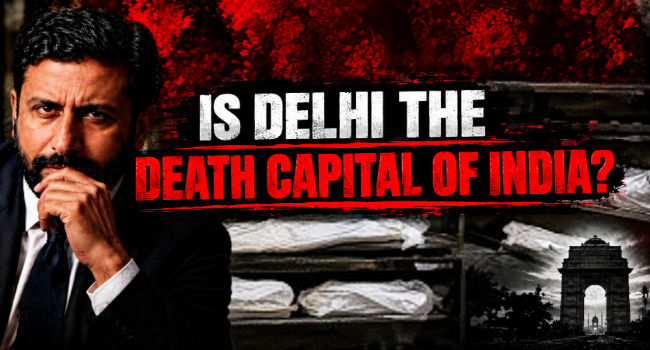
- Ravi Prakash

Yes… today I am deeply pained — not only as a journalist, but as a father. Six children have lost their lives in Delhi. This is not merely the story of a building that collapsed. What collapsed in Delhi was not just a structure — a system collapsed, right before our eyes.
But before turning to politics, government, the MCD, and accountability, consider this: a student named Aditya, trapped under the debris, recorded an eight-second video. He knew he did not have much time. Crushed beneath the rubble of the collapsed building, he pleaded to be saved. This was not merely a video — it was a distress call. Another student was also trapped under the debris. Rescuers tried every possible way to pull him out, but they had no proper protective equipment, no heavy machinery, no organised system — only their bare hands. Yet their determination and hope to save that boy, to bring him back alive by any means, is visible in another video that has surfaced. In this tragedy, six students lost their lives. Six bodies. Six families. Six futures.
But the real question begins here: how many actually died in this building? How many were trapped inside? How many could not get out? One eyewitness’s account is deeply troubling, and it raises the question of whether his version matches the figures given by officials. That must be verified and investigated. But when an eyewitness on the ground makes such a statement, it cannot be dismissed lightly — because the dead are asking questions, and those questions demand answers, now, not tomorrow.
A second eyewitness — a student who was present at the scene — has made an even more serious allegation, claiming that police are trying to conceal the truth and that the story being told to the public is incomplete. To be clear, this remains an allegation whose veracity must be established through an independent investigation. But it comes from someone who witnessed the terror firsthand, and such a serious claim cannot simply be ignored or drowned out with a barrage of questions before it is heard out.
Perhaps the most shocking claim in the entire episode comes from a young woman who was an eyewitness. She alleges that the building carried an MCD warning board declaring it unsafe. If true, this means the building’s unsafe status was already known — yet students continued to live there. Why was it not vacated? Why was it not sealed? Why were students allowed to remain? Who knew? Who saw it? Who ignored it? These are not political questions — they are questions of human life.
Having seen every video — a student pleading “save me” from under the rubble, ordinary citizens fighting with their bare hands to save lives, the bodies recovered, and the eyewitness accounts — this is not a moment for sympathy or condolence alone. What is required is accountability. The question is not simply why the building collapsed, but a larger one: whose responsibility was it to ensure the building was safe before it collapsed?
This incident occurred in Delhi, where the Central government is run by the BJP, the Delhi government is run by the BJP, and the MCD is controlled by the BJP. There must be no blame game between departments, no routine deflection of “this is not our responsibility.” A direct answer is owed: Who is responsible? Who was meant to inspect this building? Who was meant to verify its legal status? Whose duty was it to ensure the safety of the students living there? Whose duty was it to act on any violations? If the building was unsafe, why were students still living in it?
This is where the story becomes even more disturbing. If the claim of a prior safety warning is accurate, why was the building not vacated, why were students not moved out, and why were they allowed to keep living there? And if genuinely no one knew, why did no one know — isn’t that precisely the system’s job? A system is not one that arrives after disaster strikes to say “we are reviewing the situation.” A system exists to prevent the disaster in the first place.
There is no need for another photo opportunity — a politician standing near the rubble, speaking with officials, making statements before cameras, declaring “we are closely monitoring the situation.” This is a familiar script: tragedy, the arrival of politicians and officials, condolences, statements, promises of strict action — and within days, the story fades, only for the cycle to repeat. This is not what people want. They do not want spectacle, photo opportunities, or promises, nor visits that come only after lives are lost. Action must come before lives are lost — that is what people are asking for.
Today this is asked not merely as a journalist, but as a father. These six are not numbers or statistics — they were someone’s children, someone’s son, someone’s daughter, an entire family’s future. Their parents sent them to Delhi to study, to build a career, to build a life — not to die, and certainly not to die in an unsafe building.
Tomorrow another student will arrive in Delhi, take a room, and live in some building. Who then will guarantee that building is safe? The MCD? The Delhi government? The police? The building’s owner? Who? An answer is owed. It cannot be acceptable to say “we’ll look into it after the building collapses” — that is not governance. Rescue personnel are doing their job at the site right now, clearing debris, searching for survivors, fighting to save lives, and they deserve salute. But once the rescue operation ends, another process must begin — a process of accountability: who knew, who inspected, who approved, who neglected, who failed to act. Who, ultimately, is answerable for this, and whose responsibility is it to respond?
One thing must be remembered: rescue is not governance, compensation is not governance, condolence is not governance — prevention is governance. If a building was known to be unsafe, if students continued living in it, if that building stood in the heart of Delhi, and if its collapse took the lives of young people, then someone must answer, and someone must take responsibility — not in a press conference, not in a photo opportunity, not with yet another promise of “strict action,” but with real answers. Because beneath this rubble today lie not only bodies, but questions — questions that cannot be buried in the soil, cannot be covered up, and cannot be escaped through a blame game. The dead are asking questions. Delhi’s leaders owe them answers — not tomorrow, not the day after, but now.