





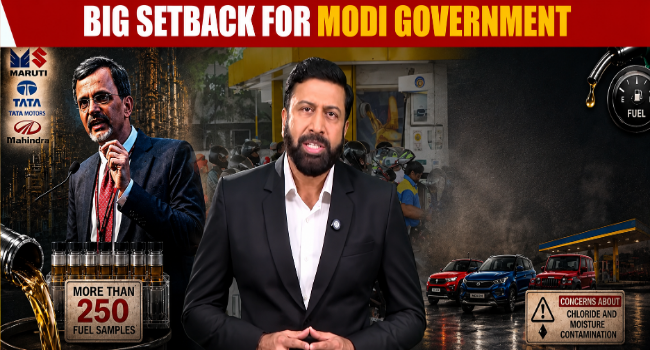
In our last article, we discussed the Reuters investigation into E20 petrol. Automobile companies like Maruti, Tata Motors, and Mahindra have already tested more than 250 fuel samples. Based on the results revealed in those tests, concerns emerged that fuel contamination could be happening due to chloride and moisture. But now another big twist has come into the E20 story. Because this time, the one asking questions about E20 is not some activist. Not an opposition leader. Not even a social media influencer. It’s India’s Chief Economic Advisor, V. Anantha Nageswaran. Yes, now the government’s own key economic advisor has given an important suggestion on E20. In an article recently published in the Indian Express, Anantha Nageswaran, along with Akash Poojary, made this suggestion — that E10 petrol should be brought back into availability for older vehicles. Yes, E10. That lower-ethanol-blend petrol which has now almost disappeared from our petrol pumps. So why should E10 be brought back again? That’s the real question now.
According to the CEA’s article, India has around 7.5 to 8 crore old two-wheelers manufactured before BS4. That’s not some small number. All of these don’t run on fuel injection systems like today’s modern vehicles. Many of these vehicles still have carburetor systems. This, the article says, is exactly where the real problem with E20 begins. Because E20 has a higher ethanol percentage. This means there’s also more oxygen in the fuel. The CEA says that old carburetor vehicles may not be able to adjust to this extra oxygen as easily as a modern fuel injection system can. And the problem doesn’t end there. The rubber seals in old vehicles could be another issue. Because not all rubber seals are compatible with ethanol. If fuel containing ethanol is used for a long time, there’s a chance the seals could get damaged. Now recall that number once again. Seven and a half to 8 crore vehicles — that means this isn’t a problem for a handful of vehicle owners. This is something that affects crores of vehicles.
And here’s where another interesting point comes out. According to the article, India’s original ethanol roadmap had already envisioned keeping lower-ethanol petrol available for older vehicles. That is, it was planned that there would be two options — E10 for old vehicles, E20 for new vehicles. But that E10 option gradually disappeared from petrol pumps. That’s why experts are now saying — bring back E10. Keep E10 available alongside E20. But the suggestion doesn’t stop there. There’s another big recommendation too — stop right at E20. In other words, don’t keep increasing the ethanol percentage any further. Why? Because in their view, the E20 debate isn’t just a vehicle-engine issue. Behind it lies another big question that affects the entire country — food versus fuel. That is, should crops be used for food, or should they be used for fuel? That’s the real debate now. That’s why the E20 story isn’t just a petrol-engine story. It’s a bigger discussion that ties together vehicles, farmers, food, and oil, all at once. This is where the E20 story starts getting even more interesting.
Now let’s talk about the biggest controversy around E20. Is E20 actually damaging cars and vehicle engines? That’s the big question in front of everyone right now. However, a recent analysis is giving some clarity on this. According to it, there isn’t strong evidence to support the claim that engines are being damaged because of E20. Some tests conducted in the US have been cited as examples for this. These include tests carried out by the Oak Ridge National Laboratory. In these tests, 86 vehicles were run for over a crore kilometers. These tests were conducted with ethanol blends up to E20. And it was found that even vehicles not specifically built for E20 did not show any additional engine wear. It’s stated that similar results came out of tests conducted in India as well, jointly by ARAI, the Indian Institute of Petroleum, and Indian Oil. So there’s an important difference we need to understand here. E20 is not the same as contaminated E20. That is, well-manufactured, good-quality E20 is one thing, and contaminated E20 is another. These two shouldn’t be viewed as the same.
This matters because, as we discussed the other day, the Reuters investigation revealed that there is concern within industry circles about the possibility of fuel samples being polluted by chloride and moisture. That’s a separate matter. One question is — does properly manufactured E20 damage the engine? The second question is — is fuel quality being properly maintained from production all the way to the pump? These are two different questions. That’s why, when it comes to E20, we’re actually looking at two different debates. Number one — is properly manufactured E20 safe for new vehicles? Number two — is quality being properly maintained across the fuel supply chain? These two things shouldn’t be mixed up. But this analysis does point to one real issue — old vehicles. It’s estimated that India has around seven and a half to 8 crore old two-wheelers manufactured before BS4. Many of these still have carburetor systems. This is exactly where a technical problem with E20 could arise. Because E20 has more ethanol, which means more oxygen in the fuel too. When oxygen increases, a modern fuel injection system can adjust accordingly. But an old carburetor system cannot adjust as easily. This means there’s a chance the engine could run hotter than usual. Then there’s another problem — rubber seals. The rubber seals in old vehicles may not have been made to withstand ethanol. If exposed to ethanol for a long time, there’s a chance they could get damaged. Changing the seals may not be a huge expense. But changing them across seven and a half to 8 crore vehicles? That’s not a small matter. It could take years.
And this is where the truly crucial point comes in. India’s ethanol roadmap had already planned in advance to keep lower-ethanol petrol available for older vehicles. That is, E10 for old vehicles, E20 for new vehicles — there were supposed to be two options like this. But the latest article says that the E10 option gradually disappeared from petrol pumps. That’s why the suggestion is very simple — bring back E10. Keep E10 available alongside E20. Old vehicles can use E10. New vehicles suited to E20 can use E20. This would also give older vehicles time for the transition. But here another big question comes up — why should India go beyond E20? That is, why go from E20 to E27 or E30? Before increasing the ethanol percentage any further, have we calculated the total benefit and the total cost this brings to the country? That’s the key question right now. Because once you go beyond E20, this isn’t just about your car anymore. Its impact could be felt across the entire country. And that’s food versus fuel. Should crops be used for food, or should they be used for fuel? That is now the real big debate over E20. This is where the E20 story becomes more serious, and more interesting.
What’s coming up now might be the single most important point in the entire E20 debate — food versus fuel. Because India isn’t just blending ethanol into petrol. It’s also using a large amount of agricultural land, crops, and water to produce that ethanol. And this is exactly where the real question begins in the long term. Just think about it — India is trying to reduce two kinds of import bills. One is the crude oil import bill — roughly 11 to 12 lakh crore rupees a year. The second is the edible oil import bill — that is, the cost of our dependence on foreign countries for cooking oils. This is around 1.6 to 1.75 lakh crore rupees a year. Now here’s the actual twist — this analysis says that the reduction in the crude oil import bill because of E20 might be only 3 to 4 percent. So the question is — how justified is it to divert such a massive scale of agricultural resources toward ethanol, just to cut down on the oil import bill? That’s the real question now.
Let’s also talk about the feedstock used in ethanol production. Maize. Corn. This analysis says that nearly half of the ethanol currently produced in India comes from corn. Not just that — it says grains account for nearly 67 percent of the total ethanol feedstock. But growing corn requires land. That same land could be used to grow soybean. Groundnut. Or sunflower. That means two needs are competing for the same land. Food or fuel? If ethanol manufacturing companies offer a guaranteed price for corn, there’s a chance farmers will lean more toward growing corn. And if that happens, this analysis says pressure could build up on the cultivation of oilseed crops. That means crops like soybean, groundnut, and sunflower could see reduced cultivation. And the problem doesn’t end there. There’s a second effect too. After ethanol is produced, the leftover grain is used as animal feed. This could also affect the price of soy meal that comes from soybean. So, going by these numbers, there’s a chance the oilseed farmer loses out on both sides.
But this isn’t just a land problem. There’s another big issue — water. This is something we almost never talk about when discussing ethanol. Water. Here, water is looked at in two categories. One is green water — that is, water that comes through rainfall. The second is blue water — that is, water from rivers, canals, borewells, and wells. Especially in states like Maharashtra and Karnataka, sugarcane cultivation is already putting pressure on water resources. That’s why it’s being said that ethanol policy needs to pay more attention to blue water consumption. Then there’s another big question — climate benefit. We often hear that ethanol is good for the environment. But this analysis says there still isn’t full clarity on the climate benefit that comes once you go beyond E20. Because you’d have to account for the entire life-cycle impact — from grain cultivation to ethanol production, including cultivation, processing, and all other inputs. One thing needs to be clearly stated here. This analysis is not saying that India’s ethanol program has failed. The ethanol program has helped in clearing dues owed to sugarcane farmers. It has provided income support in rural areas. It has created a guaranteed market for ethanol. It has also helped reduce surplus sugar stocks. So the policy does have benefits. But every policy also has costs. That’s why the real question is — have we calculated both sides of the equation? That is, how much is the benefit? How much is the cost? Have we fully calculated both of these? Because once distilleries are built, once farmers change their cropping patterns, once land and water are allocated for fuel production — turning back after that isn’t easy.
That’s why the suggestions given by Anantha Nageswaran and Akash Poojary are also very carefully framed. Bring back E10 for older vehicles. Review the incentives that are pushing more land toward corn cultivation. Reconsider the edible oil policy. And above all — hold at E20. The suggestion is that India should not move beyond E20 until the full accounting between food and fuel is properly understood. That’s perhaps the most important message in this entire analysis. Because the E20 debate isn’t just about your car. It’s also about your fuel bill. About the farmer. About food prices. About water. About energy security. And ultimately, even about the question of what India should grow. Food for its people, or fuel for its vehicles? Now, if we put together everything we’ve discussed over the last two days, the question is no longer “is E20 good or bad?” The real question is — “before going beyond E20, have we got all our calculations right?” Because some policy decisions can be changed tomorrow. But once you shift land from one crop to another, once you allocate water for fuel production, once cropping patterns change, once you push an entire industry in one direction — coming back isn’t that easy. It could be slow. It could be costly. And in the end, it could even turn painful.
Looking at everything we’ve discussed so far, one thing is clear — the E20 debate is far from over. Yesterday’s Reuters investigation raised questions about fuel contamination and the internal concerns within Maruti, Tata Motors, and Mahindra. But today, the account from India’s Chief Economic Advisor has brought another important question in front of us — before going beyond E20, have we understood its full cost? When it comes to crores of old vehicles, the suggestion is very simple — bring back E10. That is, E10 should be made available alongside E20. And when it comes to the country’s larger interests — pause. Check the data. Calculate the cost. In other words, we need to slow down a little. Examine the data fully. How much is the benefit? How much is the cost? We need to calculate that. Because this debate isn’t just about petrol. It’s about cars. About bikes. About farmers. About food. About water. About consumers. And above all, about India’s energy future. That’s why, before moving from E20 to E27 or E30, we first need to find the answer to one simple question — have we got E20 right? That is, have we correctly worked out all the calculations when it comes to E20? The answer to this question is very important. Because once the way India grows its crops changes, once the way water is used changes, once the way fuel is supplied to vehicles changes — turning back may not be easy. That’s why what this debate needs is facts, not slogans. Not slogans, but truths. Not emotions, but data. Rather than asking whether E20 is a good policy or a bad policy, the real question is — before going down this path, has India got all its calculations right? That’s the real question now.