





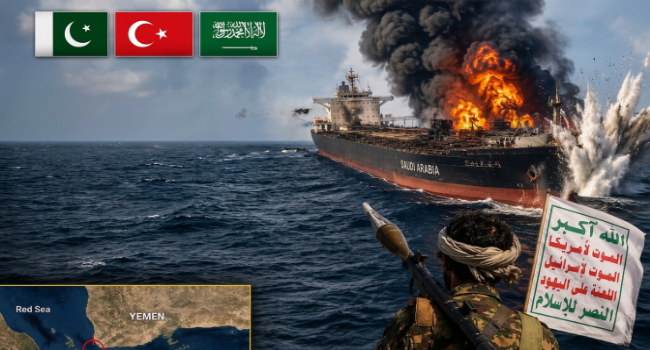
Iran-backed Houthi rebels from Yemen have resumed attacks in the Red Sea and the Bab-el-Mandeb Strait region. Saudi Arabia had recently signed a defense pact with Pakistan and Türkiye to strengthen its security shield. However, just days after this agreement was signed, the Houthis launched missile and drone attacks on Saudi military boats and oil tankers in the Red Sea, causing severe damage.
These incidents have prompted many to question what became of the defense agreement through which Pakistan and Türkiye had promised to provide security to Saudi Arabia. The Houthis targeted Saudi naval vessels and oil tankers travelling through the Red Sea. The Houthi forces announced that they destroyed these vessels because they defied the naval blockade. These attacks not only damaged several military boats but also caused massive property damage. These actions have once again put international maritime shipping in the Red Sea at serious risk.
Pakistan and Türkiye had signed an agreement to jointly resist any attack on Saudi Arabia. This defense alliance, resembling an “Islamic NATO,” failed to respond adequately when the Houthis struck Saudi targets. Criticism has emerged that these countries’ forces failed to provide direct military protection. Critics say the agreement remained confined to paper and could not withstand the Houthi missile strikes on the ground.
The Red Sea is an extremely critical route for global oil and trade transport. The continuous Houthi attacks here are deepening the security crisis in West Asia along with the global economy. Despite Saudi Arabia’s advanced weaponry and foreign defense agreements, it has become difficult for it to fully protect its coastal areas against Houthi drone and missile technology. These attacks have made it clear that the commercial and military assurances given by Pakistan and Türkiye for Saudi Arabia’s defense cannot hold up on the ground.