





- Ravi Prakash

Picture this: it’s 6 a.m., your holiday is over, and you’re flying home from Phuket. The cabin lights are dimmed, most passengers are fast asleep, and a few children rest peacefully on their parents’ shoulders. The cabin crew has just finished serving breakfast. Everything is calm. Then, in an instant, the situation changes entirely. Before drawing any conclusions, here is what actually happened aboard that flight.
The cabin crew begins shouting urgently: “Fasten your seatbelts. This is an emergency. Nobody get up. Fasten your seatbelt immediately.” The air hostess is not panicking — she is simply doing her duty, because she knows something most passengers on board do not: during severe turbulence, it is not the aircraft that is at risk, but the passengers who have not fastened their seatbelts. An elderly woman trembles with fear and begins to cry, unable to comprehend what is happening. Yet amid the chaos, the cabin crew remains composed — no shouting, no running — carefully inspecting a damaged window panel to ensure it remains secure. Damaged window panels, dislodged cabin fittings, and general disarray inside the cabin would lead any onlooker to assume the aircraft was about to go down. That assumption, however, would be incorrect. In fact, the aircraft remained safe throughout the ordeal.
Aircraft Lands Safely; 17 Injured
The aircraft landed safely in Delhi, after which injured passengers were immediately taken to hospital. Some suffered head injuries, while others were hurt after being thrown against the cabin ceiling, seats, and overhead luggage bins during the turbulence. According to reports, a one-year-old child was thrown from her seat and landed several rows away due to the severe jolts — an indication of just how dangerous the situation had become. This raises an important question: if the aircraft itself was undamaged, how did so many passengers sustain injuries? How does a plane subjected to such violent jolts still land safely? What exactly is turbulence, and does it pose a genuine risk of bringing down an aircraft? Can a seatbelt alone prevent injury during such an event? And why do aviation experts consistently emphasize the importance of keeping seatbelts fastened? This report examines the science behind turbulence — what actually happens inside an aircraft when it strikes, why the jolts occur, and what passengers should do in response.
What Happened Aboard AI2379
On the morning of August 4, Air India flight AI2379, an Airbus A320neo travelling from Phuket to Delhi, encountered severe turbulence mid-flight. Within seconds, the aircraft dropped nearly 300 feet, triggering chaos inside the cabin. Despite this, the aircraft landed safely in Delhi. However, 13 passengers and four cabin crew members sustained injuries. India’s Directorate General of Civil Aviation (DGCA) is investigating the incident. Key questions have emerged: how did the aircraft suddenly drop 300 feet? Did the pilots lose control? Did the engines fail? Was the aircraft at risk of crashing? The answer to all three is no — and understanding why requires a basic reconsideration of how aircraft actually travel.
Understanding Turbulence: An Invisible Ocean
Most people think of an aircraft simply as a machine that flies through the sky. In reality, a plane does not travel through “sky” in the abstract — it travels through air, which, though invisible, behaves much like an ocean. Understanding this single concept makes turbulence far easier to grasp.
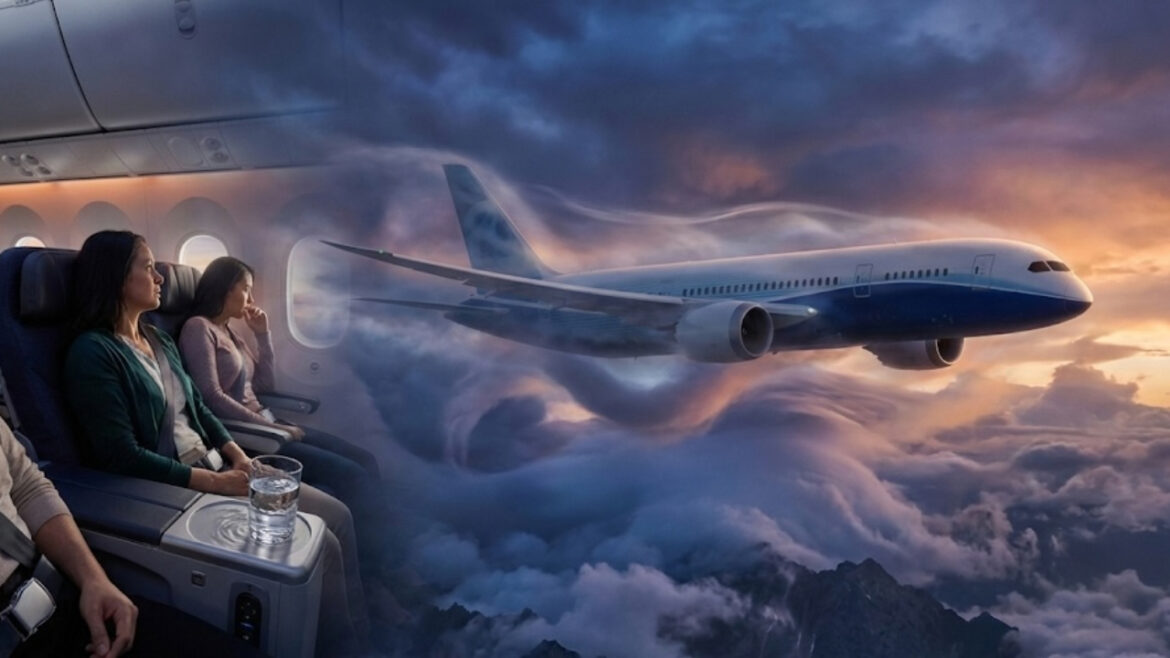
Consider a small boat in the middle of a pond. Initially, the water is calm. Then a large wave arrives, lifting the boat before it descends again; another wave strikes, causing the boat to sway. Nothing has gone wrong with the boat — the water moved, and the boat moved with it. Now replace the boat with an aircraft, and the water with air. At roughly 35,000 feet above the earth, the same principle applies. The only difference is that water is visible while air is not — yet air moves in much the same way: rising, falling, flowing rapidly, and sometimes moving in waves. Aircraft travel through this invisible medium. Most of the time it remains calm, but occasionally it turns turbulent, causing the aircraft to sway along with it. This is what passengers perceive as turbulence. The question, then, is why the air suddenly changes — and how these invisible waves form.
The Jet Stream Factor
One major cause is the jet stream — a fast-moving river of air across the sky. Consider standing at the edge of a river: water in the middle flows swiftly, while water near the bank moves more slowly. A boat travelling between these two speed zones would shake. A similar phenomenon occurs in the sky. At around 35,000 feet, air currents known as jet streams move at speeds exceeding 200 kilometers per hour. Aircraft frequently use these jet streams because they save fuel and reduce flight time. However, the real hazard lies not within the jet stream itself but at its edges, where air moving at high speed meets air moving more slowly. This difference in speed — known as wind shear — causes the airflow to change abruptly.
Imagine two people pulling a bedsheet from opposite ends: initially it remains smooth, but excessive pulling causes it to crease. Air behaves similarly. When wind speed differentials arise, a smooth airflow becomes turbulent, generating invisible waves of air. This phenomenon is known as clear air turbulence — a condition even pilots cannot anticipate.
Why Turbulence Is Dangerous — and Difficult to Predict
Notably, the most dangerous turbulence frequently occurs when the sky appears entirely calm — no clouds, no rain, no lightning. Pilots are often unable to detect it in advance because an aircraft’s weather radar does not directly detect air; it relies on reflected signals from elements such as rain, water droplets, and large clouds. In dry air, no such signals exist, so the radar screen shows nothing unusual — yet the aircraft can enter turbulence within moments. This is why it is termed clear air turbulence: not because it is unusually severe, but because it strikes without visible warning. As a result, pilots do not rely on radar alone; they also consult weather data and reports from aircraft that have flown the same route earlier, before determining a course of action.
This raises another critical question: if aircraft are engineered to withstand such violent jolts without damage, why do passengers get thrown from their seats and strike the ceiling? What exactly happens inside the cabin during such an event?
If the Aircraft Is Safe, Why Are Passengers Injured?
This is the central mystery of such incidents. Modern aircraft are designed to fly safely even through turbulence — so why do passengers get injured, and in some cases strike the ceiling? To understand this, consider a simple, everyday scenario: standing inside a lift that suddenly begins descending rapidly. In that instant, your body feels lighter. If the lift accelerates further downward, your feet begin losing contact with the floor, and for a few moments you feel as though you are floating. Precisely the same phenomenon occurs inside an aircraft during severe turbulence.
Returning to the Air India incident: the aircraft dropped nearly 300 feet within seconds. Crucially, the aircraft did not “leave behind” its passengers — as the plane moved, every object inside it, in accordance with the laws of physics and inertia, attempted to continue moving in its original direction. A passenger wearing a seatbelt moves along with the aircraft; they may experience a strong jolt and considerable fear, but they remain secured in their seat.
Now consider a passenger who has just removed their seatbelt, is walking toward the washroom, is a child standing on a seat, or is opening an overhead bin — nothing secures their body to the aircraft. When the plane suddenly drops, their body does not immediately follow; for a brief moment, it continues moving in its original direction. From inside the cabin, it appears as though the passenger has been thrown upward — but in reality, the aircraft moved downward while the passenger remained roughly where they were. When the aircraft subsequently moves back upward, injuries occur, as the ceiling, armrests, seat frames, overhead compartments, and service trolleys effectively become hard-impact objects.
This explains why many passengers strike the ceiling before falling back into their seats, why luggage falls from overhead bins, and why the one-year-old child aboard AI2379 was reportedly thrown several rows. Cabin crew members sustain the highest rate of turbulence-related injuries — not due to carelessness, but because their duties require them to remain standing and serving passengers rather than seated.
Can Turbulence Bring Down an Aircraft?
This is the question that concerns nearly every air traveler: can turbulence genuinely cause a passenger aircraft to crash? The answer is no. Modern commercial aircraft are specifically engineered with turbulence in mind — engineers are well aware that every aircraft will encounter turbulence thousands of times over its operational life. Consequently, aircraft are not built for smooth skies but designed to withstand rough conditions.
Aircraft wings, contrary to popular assumption, are not rigid — they are deliberately engineered to flex, much as a tall building is designed to sway slightly during an earthquake. This flexibility allows the wings to absorb substantial force. During certification and manufacturing, wings are tested under forces far exceeding those encountered in normal flight operations, during which they bend upward by several meters without breaking. Passengers who observe the wings flexing during turbulence should not be alarmed — this indicates the aircraft is functioning exactly as its engineers intended.
Returning to the Phuket-Delhi flight: although passengers were extremely frightened and the cabin descended into chaos, the pilots at no point indicated that the aircraft was in danger of crashing or breaking apart. The cabin crew simply and repeatedly instructed passengers to remain seated with seatbelts fastened — because they understood something many passengers did not: the aircraft itself was built to withstand the turbulence. The genuine risk lay not outside the aircraft but inside the cabin.
Notably, according to aviation safety studies, the majority of turbulence-related injuries result not from damage to the aircraft but from passengers failing to wear seatbelts. Cabin crew members are disproportionately affected precisely because their duties require them to stand and serve passengers, leaving them more vulnerable if turbulence strikes unexpectedly. This is why pilots repeatedly issue the same standard instruction: “Please remain seated with your seatbelt fastened at all times while seated.” Many passengers, however, disregard this guidance — loosening or removing seatbelts, standing to use the washroom, or opening overhead bins. In most instances, nothing untoward occurs — but on occasions when severe, unwarned turbulence strikes, those few seconds can prove decisive.
What Passengers Should Do
While turbulence itself cannot be controlled, the risk of injury from it can be significantly reduced through several precautions:
First, and most straightforward: keep your seatbelt fastened at all times while seated — not merely when the seatbelt sign is illuminated. It can be worn loosely enough to go unnoticed, yet this single habit can prevent serious injury during unexpected severe turbulence.
Second, avoid standing unless absolutely necessary. Passengers needing to use the washroom should do so well in advance rather than waiting until the last moment, since clear air turbulence cannot be predicted even by pilots.
Third, exercise caution with overhead bins — avoid forcing overpacked bins shut, and refrain from opening them immediately after turbulence occurs, as dislodged luggage can cause serious injury.
Passengers travelling with children should keep close watch over them whenever possible, as young children are unable to protect themselves during sudden turbulence. Finally, passengers are urged to follow all instructions issued by cabin crew without delay — such instructions, including requests to return to one’s seat, are issued not to cause inconvenience but out of an understanding, born of extensive training, that turbulence arrives without warning.
The next time a flight begins to shake, passengers are advised not to assume the aircraft is going down. Much as a boat travels over ocean waves, an aircraft travels over invisible waves in the sky — and is specifically engineered to do so safely. The real question is one of passenger preparedness. In many cases, the difference between walking away unharmed and requiring hospitalization amounts to nothing more than a seatbelt fastened in two seconds. Safe flying.