





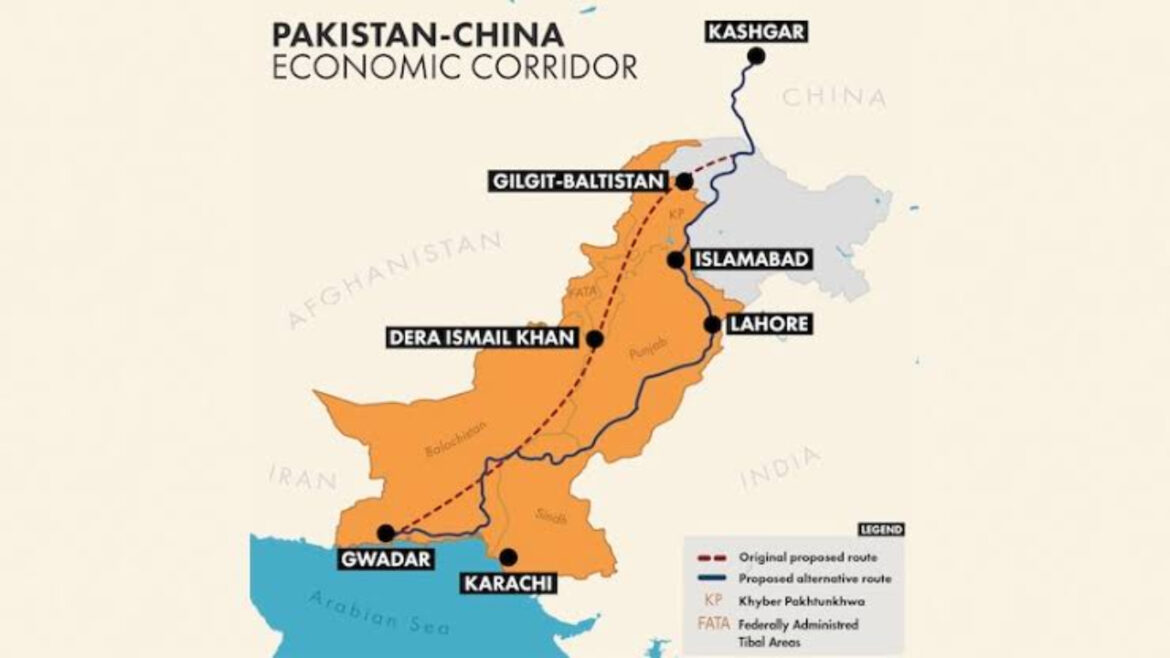
Balochistan, which has for decades resisted what it describes as domination and exploitation by Pakistan, has made a sensational declaration announcing itself as an independent nation. While the move has not yet received official international diplomatic recognition, it is sending shockwaves through South Asian geopolitics — and has thrown the future of the China-Pakistan Economic Corridor (CPEC), a flagship project for both Islamabad and Beijing, into serious doubt.
CPEC’s Strategic Stakes
CPEC forms the most critical component of China’s ambitious Belt and Road Initiative (BRI). Built at a cost of nearly $65 billion (over ₹6.2 lakh crore) and spanning roughly 3,000 kilometers, the corridor links the strategic deep-water Gwadar port in Balochistan to China’s Xinjiang region via a network of highways, railways, and pipelines. The project was designed to give China direct access to the Arabian Sea. That ambition is now in jeopardy following the uprising in Balochistan.
Gwadar Port: The Central Question
Control of Gwadar Port has emerged as the most pressing issue in the unfolding crisis. Geographically, the port lies within Balochistan’s territory, and under international norms, regional sovereignty would rest with the newly declared state. Currently, the Chinese state-owned China Overseas Ports Holding Company (COPHC) manages port operations under an agreement signed with the Pakistani government — but that agreement confers only operational rights, not sovereignty.
Should Balochistan consolidate as a fully independent state, it would face no legal obligation to honor the trade and defense agreements Pakistan previously entered into on its behalf. A newly formed Baloch government would have full authority to annul or renegotiate these arrangements — a scenario China is watching with alarm, given precedent set by other nations that revisited legacy agreements over natural resources and strategic assets after gaining independence.
A Corridor at Risk of Collapse
Analysts note that Gwadar functions as the southern gateway to the entire CPEC framework. Should Pakistan lose control of the port, the corridor’s current structure would effectively collapse. To keep the project alive, China would need to bypass Islamabad entirely and negotiate fresh terms directly with any new Baloch administration. Absent such a shift, transport infrastructure linking Gwadar to Pakistan’s interior risks becoming commercially and politically obsolete.
Security Concerns for Chinese Nationals
The development has also raised serious questions about the safety of thousands of Chinese engineers and technical personnel working on CPEC, all of whom operate under visas and permits issued by Pakistan. Any change in the legal and administrative status of the region could complicate their continued presence. The Gwadar area has already seen sustained security threats to Chinese citizens and infrastructure from separatist groups; further escalation could sharply increase security and insurance costs, adding a heavy financial burden for Beijing.
Roots of the Uprising
Local Baloch groups have long alleged that the province receives no meaningful share of revenue generated by Gwadar Port, with proceeds accruing instead to the Pakistani government and Chinese companies. Analysts point to this grievance — resentment over the extraction of natural resources without corresponding local development or employment — as the central driver behind the independence declaration.
A declaration of independence does not, on its own, redraw international borders overnight, nor does it immediately halt the CPEC project. But the rapid erosion of Pakistani state control over Balochistan presents an increasingly difficult challenge for Beijing. What began as a security concern for a heavily invested China now appears to be evolving into a broader geopolitical crisis with potentially lasting international consequences.