





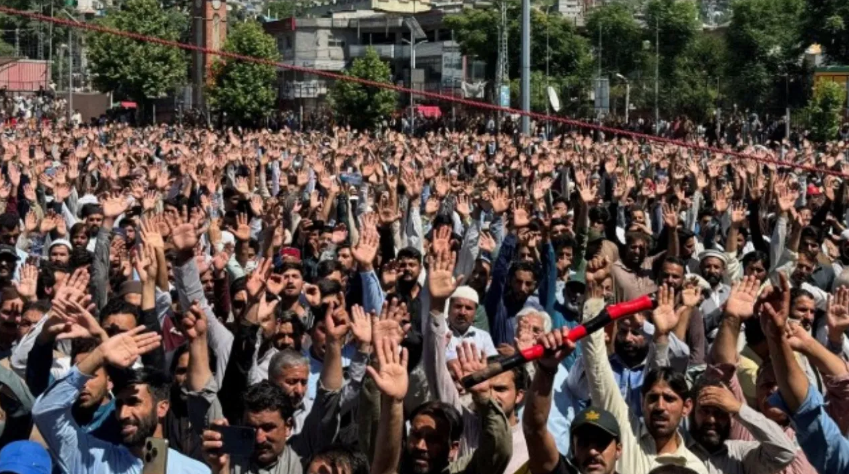
Pakistan-occupied Kashmir (PoK) is witnessing growing public unrest as residents protest against worsening economic conditions. People across the region have staged demonstrations, alleging a lack of basic facilities and inadequate government support. Rising prices of essential commodities, increasing electricity tariffs, and unemployment have emerged as major concerns for local communities.
Protesters claim that the economic situation in PoK has deteriorated significantly in recent years. The absence of major industries has limited employment opportunities, particularly for the youth. Residents allege that the Pakistani government has failed to undertake meaningful development initiatives, leaving many families struggling to cope with inflation and declining income sources.
BIG – PoK Erupts in Protest.
Thousands of demonstrators from across Pakistan-occupied Jammu and Kashmir assembled in Rawalakot, voicing strong opposition to Pakistan's rule and its policies in the region.
Unprecedented scenes from POK !!
Anger has surged across the region… pic.twitter.com/qF5D03oYGv
— News Algebra (@NewsAlgebraIND) June 10, 2026
PoK is divided into two regions—Azad Jammu and Kashmir and Gilgit-Baltistan—covering a total area of 90,972 square kilometers. Although Azad Jammu and Kashmir has its own constitution, prime minister, and president, critics argue that key administrative and political decisions remain under the influence of Pakistan’s military and federal government. Gilgit-Baltistan was brought under Pakistan’s control through the 1949 Karachi Agreement.
The Joint Awami Action Committee (JAAC) has demanded the abolition of 12 refugee-reserved seats in the 45-member assembly. Protesters allege that these seats are largely occupied by political figures from Pakistan’s Punjab and Sindh provinces, reducing local representation. They further claim that peaceful demonstrations against the arrangement were met with force, resulting in 32 deaths and more than 200 injuries. The government has reportedly described some of the protesters as militants.
According to reports, Pakistan has reduced PoK’s budget from 75 billion to 63 billion rupees. At the same time, unemployment in the region rose to 11 percent during 2024-25. Despite a literacy rate of 77.5 percent, many young people continue to face difficulties in securing jobs. Critics say declining per capita income and limited economic opportunities have intensified public dissatisfaction, fueling demands for greater development and representation in the region.