





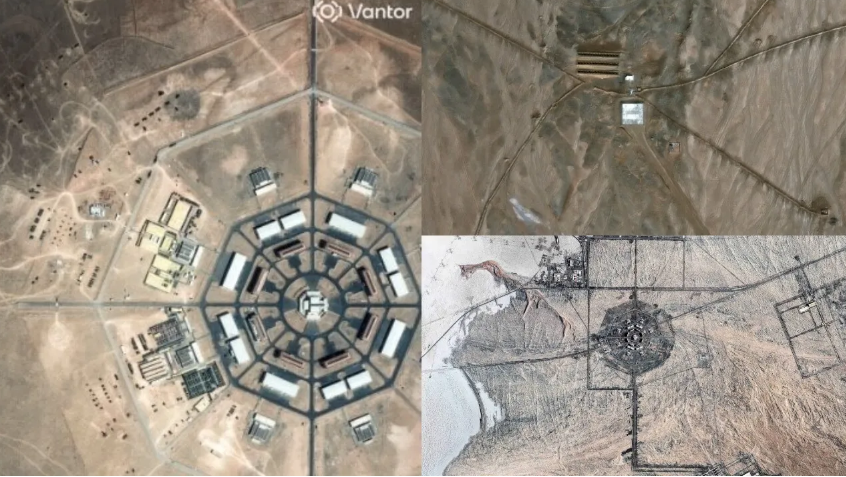
China is reportedly accelerating the expansion of its strategic military infrastructure, with new satellite imagery revealing the construction of extensive nuclear missile-related facilities across remote desert regions of eastern Xinjiang and Gansu Province. The developments have drawn significant attention from international defense analysts amid growing geopolitical competition between China and the United States.
According to defense experts, the newly identified infrastructure consists of large concrete launch pads spread across thousands of square kilometers. Analysts believe the facilities could be used to support China’s road-mobile Intercontinental Ballistic Missile (ICBM) launchers, air defense systems, and electronic warfare assets, strengthening the country’s strategic deterrence capabilities.
Satellite imagery suggests China is rapidly expanding hardened infrastructure around its nuclear missile silo fields in Xinjiang.
– 80+ launch pads near ICBM silos
– Bunkers, air-defense sites & communications nodes
– Facilities linked to mobile missile launchers and command… pic.twitter.com/uhhQxw14pW— Netram Defence Review (@NetramDefence) May 31, 2026
The construction activity is reportedly centered around a network of octagon-shaped military complexes that China has been developing over the past several years. These installations are believed to function as major command and logistics hubs, incorporating troop housing, airfields, railway connectivity, and support facilities for large-scale military operations.
Satellite assessments indicate that the complexes are supported by extensive transportation networks, fortified bunkers, underground weapons storage facilities, and missile launch sites. Advanced communication infrastructure, including microwave transmission systems, satellite communication equipment, and specialized communication towers, has also reportedly been established across the region.
Defense analysts say the expansion reflects China’s broader efforts to strengthen the survivability of its nuclear forces. Beijing has long adhered to a “No First Use” nuclear policy, under which it pledges not to initiate a nuclear strike but maintains the capability to launch a retaliatory response if attacked.
Experts believe the development of mobile launch platforms and integrated air defense systems is designed to enhance China’s second-strike capability by ensuring that its nuclear arsenal can survive a potential preemptive attack on fixed missile installations. The mobility of these systems would allow China to disperse strategic assets and maintain operational readiness under conflict scenarios.
According to estimates by the Pentagon, China has already deployed approximately 100 intercontinental ballistic missiles within its principal missile silo fields. The U.S. Department of Defense has also projected that Beijing is working toward expanding its nuclear arsenal to at least 1,000 operational nuclear warheads by 2030.
The latest revelations come amid heightened tensions between Washington and Beijing over Taiwan, military activity in the Indo-Pacific, and competing territorial claims in the South China Sea. The emergence of additional missile infrastructure has intensified concerns among Western defense planners regarding the scale and pace of China’s ongoing military modernization program.
Defense observers note that the expansion of strategic missile infrastructure, coupled with advances in air defense, communications, and electronic warfare capabilities, underscores China’s growing emphasis on strengthening its long-term deterrence posture and enhancing its ability to operate in a high-intensity conflict environment.
The satellite findings are expected to further shape international discussions on nuclear deterrence, strategic stability, and the evolving balance of power between the world’s leading military powers.