





- Ravi Prakash
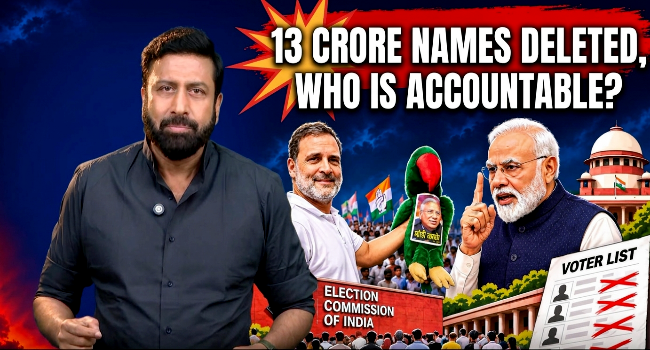
he Special Intensive Revision (SIR) launched by the Election Commission in the name of cleansing the electoral rolls has turned into a major controversy. The deletion of more than 13 crore names, objections raised by two Election Commissioners themselves, a dispute over Form-6, the Opposition’s agitation and the BJP’s counterattack all bring one question to the fore: is the voter list being cleansed, or is the right to vote, the lifeblood of democracy, being put at risk? Doubts are being voiced on all sides.
A problem that began with SIR
At the center of the controversy is the SIR exercise. The Election Commission says its purpose is to remove from the rolls the names of the dead, those who have moved elsewhere, those registered more than once, and ineligible persons. It also maintains that its goal is to ensure that every eligible person gets the right to vote.
As part of the exercise, more than 13 crore names have been removed from the draft electoral rolls of various states and Union Territories. That figure includes the dead, those who have moved away, and duplicate entries, so it cannot be assumed that everyone removed was an eligible voter. Yet key questions remain. How many of those removed genuinely had the right to vote? How many were dropped by mistake? How easy is it to get one’s name registered again? The absence of clear answers is fueling the dispute.
Two Commissioners raise objections
Another notable aspect has emerged. According to an investigative report by The Indian Express, Election Commissioners Sukhbir Singh Sandhu and Vivek Joshi objected to certain aspects of the process at least 14 times over nearly ten months. The report says they asked how the revision of electoral rolls should be conducted, who has the authority to make changes to Form-6, what role field-level officials should play, and how reasonable it is to centralize decisions through software.
The Form-6 dispute
The controversy centers especially on Form-6, the application form used to register as a new voter. Under SIR, an additional declaration was attached to the form, seeking details on whether the applicant’s name, or those of their parents and grandparents, appeared in the rolls of a previous intensive revision.
The two Commissioners reportedly questioned whether it was appropriate to attach such a declaration to the statutory Form-6, and whether the legal amendments required for it had been made. The Indian Express report also states that one of them described the procedure as unofficial and illegal. It is significant that these objections came from two Commissioners within the Election Commission, and not as allegations by the Opposition.
EC says Form-6 was not altered
The Election Commission has offered its own explanation. It said no changes whatsoever were made to Form-6, that a separate declaration was prepared specifically for SIR, and that attaching it to the online application was merely for convenience. It added that all three SIR-related orders were issued with the consensus of all three Commissioners.
In the wake of the controversy, however, the way the declaration appears in the online Form-6 has changed. In states where SIR has been completed, the additional declaration has been removed from the online form. It was later decided to separate the declaration from Form-6 and modify it to be closer to the procedure in the physical application.
On November 3, the Commission issued another key clarification: those whose names are missing from the draft roll can apply again through Form-6, and they will face no criminal action merely for reapplying. A question now arises, however. If the originally designed procedure was clear, why were so many changes needed afterward?
INDIA bloc takes to the streets
The administrative dispute over the Commission’s process has become a nationwide political fight. On November 1, the INDIA bloc held a massive protest at Ramlila Maidan in Delhi. Led by Rahul Gandhi, the agitation was attended by several Opposition leaders, including Mallikarjun Kharge, Sonia Gandhi and Akhilesh Yadav.
The Opposition alleged that, in the name of SIR, the names of genuine voters are being deleted, and that an attempt is being made to alter the electoral rolls in favor of the ruling BJP. Rahul Gandhi demanded the resignation of Chief Election Commissioner Gyanesh Kumar. Describing the matter as “vote chori” (vote theft), he called for action against those responsible, and linked these developments to the Opposition’s earlier allegations of irregularities in the electoral rolls in previous elections.
However, no confirmed evidence has so far emerged for the allegation that SIR was deliberately designed to benefit the BJP. While the Opposition bears the responsibility of proving its allegations, the Election Commission also bears the responsibility of making clear that there is no scope for irregularities in the revision of electoral rolls.
BJP hits back
The BJP has completely rejected the Opposition’s criticism. It argues that SIR is merely a legitimate process of cleansing the electoral rolls, that removing ineligible names and duplicate entries is the Commission’s responsibility, and that portraying it as the deletion of voting rights is improper. BJP leaders have counterattacked, saying Rahul Gandhi and the Congress are creating unnecessary fear among the people and undermining trust in constitutional institutions such as the Election Commission.
Union Home Minister Amit Shah also threw a challenge to Rahul Gandhi. He announced that the government is ready to discuss the SIR issue and that, if necessary, it can be debated even in a special session of Parliament. Even as the war of words between the Opposition and the ruling side continues, no clear solution to the underlying problem is yet in sight.
Goa case highlights software problem
The Goa episode has emerged as another key element in the dispute. It has been reported that, according to an affidavit the Election Commission submitted to the Supreme Court, the names of 97 voters in Goa were dropped from the draft roll. Local electoral registration officers subsequently examined their cases and found all of them to be eligible.
The Commission stated in the affidavit that there was initially no proper provision in the ECINet software to add their names back to the final roll. The State Chief Electoral Officer therefore intervened and directed that the names be restored. The Commission said that, of the 97, 88 applied again through Form-6 and their applications were accepted.
The number may be very small compared with the more than 13 crore names removed nationwide, but the episode makes clear that eligible voters’ names can be deleted by mistake. When election officials themselves recognize that a person’s name was removed in error, why should that person have to apply afresh from the beginning? How many other places in the country face similar problems? How many names were removed, how many objections were received, and how many names were ultimately restored? The Election Commission needs to place these details before the public, state by state.
Who ensures the voter’s right?
The controversy is set to become even more crucial in the coming days, with elections due soon in several key states, including Uttar Pradesh. The electoral roll is not merely a document of names and addresses. It is the key foundation that determines who can vote in a democracy and whose voice should be heard through elections. Ineligible names should not remain on the list, and at the same time, not a single eligible voter’s name should be deleted by mistake. Ensuring both is the Election Commission’s responsibility.
In light of developments such as the objections of two Election Commissioners, the changes to Form-6, and the deletion of eligible voters’ names in Goa, the Commission needs to provide greater clarity. The BJP should answer the Opposition’s allegations with evidence, and the Opposition, too, should present adequate evidence for its charges. Above all, the Commission must place complete information before the public, state by state.
In a democracy, the most important name on the electoral roll is not that of any political leader, but that of an ordinary citizen. Merely conducting elections is not democracy. True democracy is giving every eligible person the opportunity to vote.