





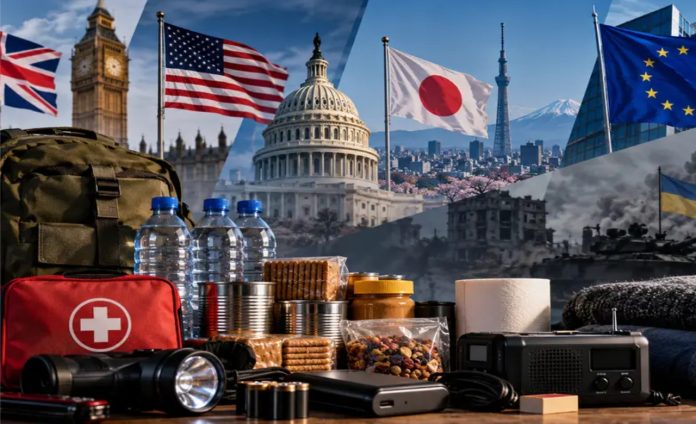
Governments in Britain, the United States, Japan and several European countries are issuing advisories asking citizens to keep emergency supplies at home so they can manage independently for at least 72 hours, or three days, in the event of a crisis. Officials have made clear that the advisories do not signal an impending Third World War.
The measures come amid the Ukraine-Russia war, cyber-attacks, the threat of sabotage against critical infrastructure, and natural disasters such as severe storms and floods. Authorities note that in the first hours of a crisis, rescue teams and emergency services may be unable to reach everyone immediately, as hospitals and essential services must be prioritised. Self-reliance for 72 hours is therefore considered crucial for families.
Officials recommend that an emergency kit include adequate drinking water, non-perishable food, a torch with spare batteries, a first-aid kit and essential medicines, a power bank, a wind-up radio and some cash.
Preparedness measures vary by country. In Britain, the “Be Ready” campaign urges households to stock three days’ worth of supplies in view of storms and power outages. In the United States, the Pentagon’s “FORTRESS” plan is strengthening its network so that key military bases can operate for 90 days without outside assistance. Japan, which is prone to earthquakes, has advised households to prepare supplies for three days to a week. In Europe, Finland has raised its food grain reserves to cover nine months, while Sweden, Poland and other countries have accelerated civil defence measures.
Experts stress that the advisories should not be read as a sign of a looming world war. The aim, they say, is to ensure people are prepared in advance rather than panicking after a disaster strikes.