





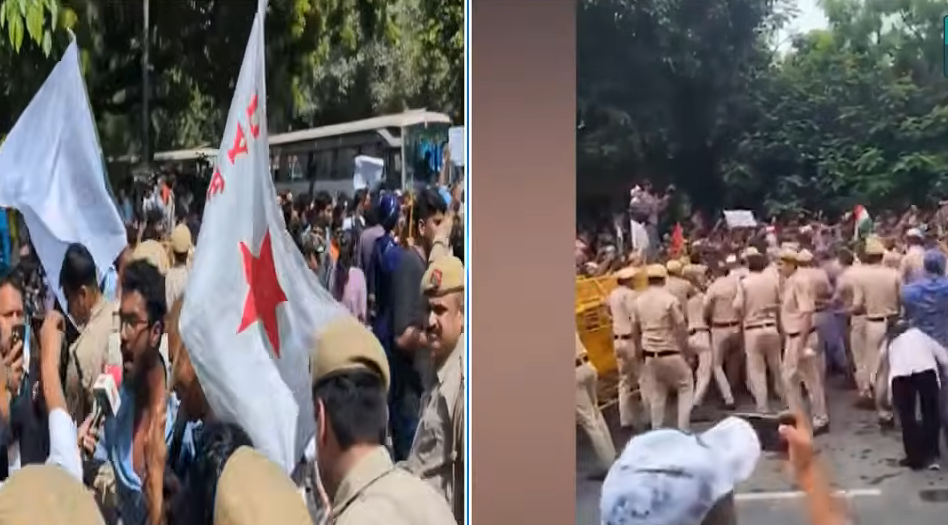
The protest movement that began in Mumbai is now moving toward the national capital, Delhi. After holding a demonstration involving thousands of young people at Shivaji Park in Mumbai on October 2, the Cockroach Janata Party (CJP) has called for a larger event at Jantar Mantar in Delhi on October 10, under the banner “Jantar Mantar 2.0.” The movement’s central demand remains the resignation of Chief Election Commissioner Gyanesh Kumar. CJP chief Abhijeet Deepke has called on young people from across the country to converge on Delhi if Kumar does not step down, signaling that the campaign is entering a new phase following Mumbai.
At the heart of the dispute is the Election Commission’s Special Intensive Revision (SIR) process. CJP alleges that irregularities occurred during the revision of voter rolls, claiming that names of eligible voters were removed from electoral lists, and has made Gyanesh Kumar’s resignation its primary demand on these grounds. The Election Commission, however, maintains that all major decisions related to SIR were taken unanimously by the Commission, and that the exercise was intended solely to update and correct voter lists. The dispute has since evolved beyond a single protest into a broader debate concerning public trust in the electoral process and the transparency of voter rolls.
CJP’s demonstration in Mumbai proceeded despite the absence of police permission for the gathering near Shivaji Park, drawing large numbers of young participants along with several figures from the film and social sectors, including Shabana Azmi, Vishal Dadlani, Naseeruddin Shah, and Prakash Raj. CJP’s leadership has described the protest as peaceful, asserting that it would continue to follow a path of non-violence. Mumbai Police, however, registered a case over the unauthorized gathering, citing significant traffic disruption and public disturbance caused by loudspeaker use, adding a legal dimension to the organization’s challenges alongside the political one.
With the Mumbai phase concluded, CJP’s attention has turned to Delhi, where Deepke has called for a large-scale mobilization on October 10, warning that “if Gyanesh Kumar does not resign, cockroaches from across the country will come to Delhi,” and that any location where police attempt to block the gathering would itself become the protest site. Security arrangements, the granting of permissions, and the scale of turnout are expected to be decisive factors in how the event unfolds.
The movement’s broader strategy also extends beyond Delhi, with CJP’s leadership announcing plans to stage demonstrations in cities including Goa, Kolkata, Patna, and Bengaluru, reflecting an effort to expand what began in Mumbai into a nationwide youth-led campaign. CJP has identified Gen Z as the central driving force of its movement, stating its goal is to mobilize young people at scale to raise questions about the electoral system.
The situation in Delhi has already grown tense, with police taking several individuals into custody and registering three FIRs following protests held at Jantar Mantar on October 2 and 3, citing violations including obstruction of government personnel on duty. Separately, The Indian Express reported that two Election Commissioners had reportedly raised internal objections to certain SIR-related decisions — a claim CJP has cited as supporting evidence for its allegations. The Commission, however, continues to assert that its decisions on SIR were arrived at unanimously.
CJP’s demands extend beyond the CEC’s resignation, including a call for a criminal case to be registered against him, for SIR to be scrapped with pre-2024 Lok Sabha election voter lists restored, and for recent amendments to electoral laws to be withdrawn, indicating that the movement seeks a wider debate on electoral processes and the Election Commission’s accountability.
With only a few days remaining until October 10, questions remain over whether Gyanesh Kumar will resign, how large a turnout will reach Delhi if he does not, and how authorities will respond to the planned demonstration. Fact-checkers have also flagged that some videos circulating online in connection with the protests date back to 2024 rather than the current movement, underscoring the need for verification amid the intensifying public debate. As the campaign builds toward its next phase, national attention remains focused on Jantar Mantar and what October 10 may bring.