





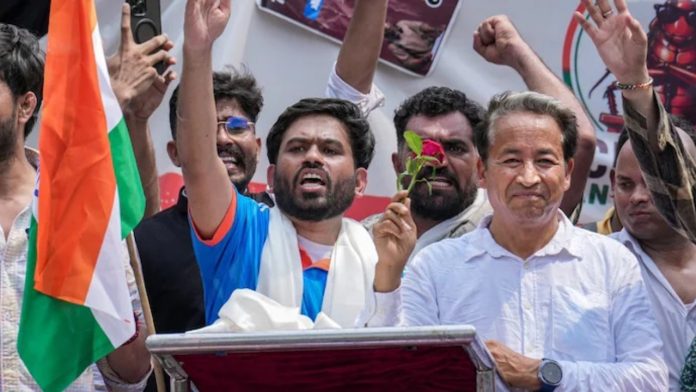
Standing as testament to the changes digital media is bringing to the political sphere, the “Cockroach Janata Party” (CJP) is creating unprecedented history. Despite not being registered with the Election Commission, this Gen-Z online movement, built purely on Instagram, has amassed a following of 2 crore. It set a new record by surpassing the Instagram follower counts of the country’s largest political parties, the BJP and Congress, in a remarkably short span of time. Notably, what began as an ordinary digital campaign eventually grew to a scale where it forced the resignation of a Union minister.
The origins of this movement trace back to remarks made by Chief Justice of India, Justice Surya Kant. The CJI had commented, “Some among the youth are like cockroaches. Without jobs or professions, they turn into journalists, social media activists, and RTI campaigners, attacking everyone.” Strongly protesting these remarks, Abhijeet Deepke — a Boston University alumnus and former AAP volunteer — launched an online campaign under the name “Cockroach Janata Party” on May 16, and within a short time, lakhs of young people joined the movement.
The CJP is currently guided by 10 key leaders. Along with Abhijeet Deepke, the movement is led by Saurav Das, Ashutosh Ranka, Vijeta Dahiya, renowned environmentalist Sonam Wangchuk, prominent actor Prakash Raj, Atul Kulkarni, Amulya Dhawan, Ronak Khatri, and Arpit Sharma. With like-minded figures from various fields coming together on a single platform, this digital movement received overwhelming support from the youth.
This Gen-Z movement did not limit itself to protests alone — it also released a sensational manifesto in its own distinctive style. It demanded that no former Chief Justice of India be given a Rajya Sabha membership after retirement, and that the Chief Election Commissioner be arrested under UAPA if voters are deleted in opposition-ruled states. Additionally, the manifesto called for 50 percent reservation for women in legislatures and cabinets, and for the licenses of media organizations owned by businessmen Ambani and Adani to be revoked.
CJP called for strict action against elected representatives in the interest of political stability. It made clear that MLAs and MPs who switch parties should face a complete 20-year ban from contesting elections or holding any position. Fueled by the anger sparked by the CJI’s remarks, and amplified by youth frustration over rising unemployment and the lack of transparency within institutions, this manifesto became a powerful voice for those grievances.
The movement rapidly expanded from social media into street protests. On June 6, as soon as Abhijeet Deepke returned from the United States, thousands of young people gathered at Jantar Mantar. Alongside the digital campaign, a massive dharna was held at Jantar Mantar on June 20, with thousands participating in the protests from June 22 to 27. The protest intensified further when Sonam Wangchuk arrived in person on June 28 and began a hunger strike. The “Cockroach Janata Party” movement demonstrated that, by wielding technology as a weapon, even institutions of power can be challenged through digital platforms.