





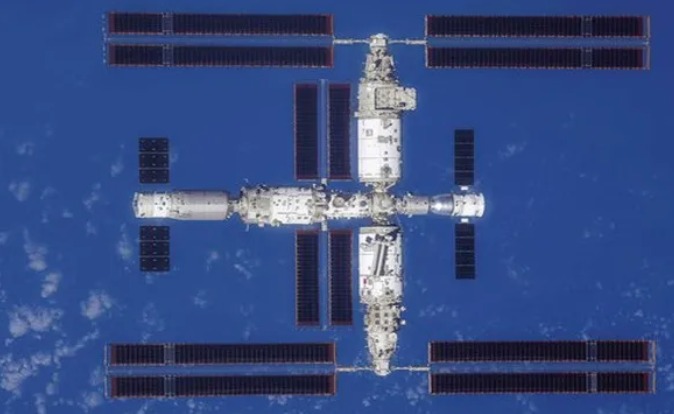
BEIJING: Chinese researchers aboard the Tiangong space station have cooled a cloud of atoms to an equivalent temperature of 9.7 picokelvin, 9.7 trillionths of a degree above absolute zero. This is the lowest temperature reported for a gas of atoms. The result was published in the journal Science on November 5 in a paper titled “Quantum gases below 10 picokelvin in space.”
The experiment was run by researchers from Peking University, the Shanghai Institute of Optics and Fine Mechanics and the Technology and Engineering Center for Space Utilization of the Chinese Academy of Sciences. It used the ultracold atom physics facility in the station’s Mengtian laboratory module.
The team trapped about 20,000 rubidium-87 atoms with laser beams and cooled them until they formed a Bose-Einstein condensate, a state in which atoms behave collectively as a single quantum wave. After releasing the cloud from the trap, they tracked its expansion for seven seconds and calculated the temperature from how slowly it spread. The estimate carries an uncertainty range of 7.0 to 12.9 picokelvin. Researchers stress that this is an equivalent temperature that characterises the atoms’ motion, not a reading of the equipment or its surroundings.
The result is about four times colder than the previous record of 38 picokelvin, set in 2021 at a drop tower in Bremen, Germany. It is also colder than the 52 picokelvin reached in 2022 by NASA’s Cold Atom Lab aboard the International Space Station. By comparison, it is roughly 280 billion times colder than the 2.7 kelvin of the cosmic microwave background.
Microgravity is what made the record possible. On Earth, gravity pulls atoms downward, which limits how weakly they can be confined and how long they can be observed. In orbit, the researchers extended the observation window to seven seconds. Longer observation increases the chances of detecting weaker physical phenomena, according to Peking University researchers Xiong Wei and Jin Shengjie, the study’s co-first authors.
The scientists say the advance could lead to more precise quantum sensors, including instruments that could map Earth’s gravity field from orbit, and to tests of whether objects of different composition fall at the same rate, a cornerstone of Einstein’s theory of relativity.