





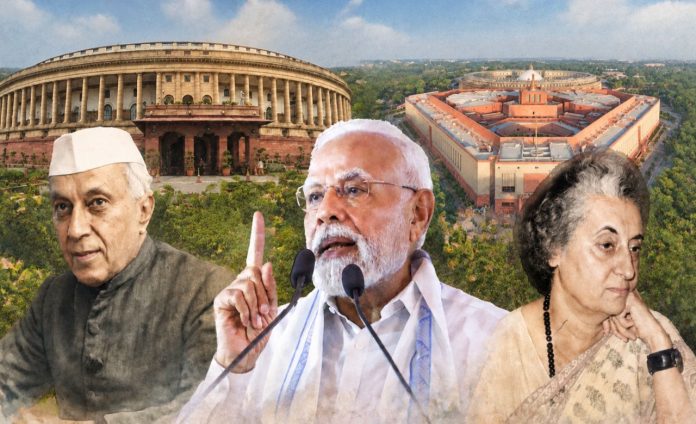
New Delhi: In a move that could reshape the country’s electoral map, the Union Cabinet has approved a proposal to raise Lok Sabha seats by 50 per cent across all states, independent of the ongoing census exercise. The bill is expected to be tabled in the special session of Parliament beginning November 30. Minister of State for Law Arjun Ram Meghwal said the House strength would increase from the present 543 to 816, with a ceiling of 850 seats.
Formula aimed at allaying southern concerns
States in the South, which successfully implemented family planning programmes, have long argued that a population-based allocation would dilute their representation in Parliament. The Centre’s new formula seeks to address that apprehension.
Under the proposal, inter-state distribution of seats will continue to be based on the 1971 Census, giving every state an identical 50 per cent increase. Within each state, however, constituency boundaries will be redrawn on the basis of 2011 Census figures. The government is also considering a cap of 650 seats for State Legislative Assemblies.
Background: Delimitation since 1936
The exercise of demarcating electoral boundaries dates to the colonial period. Following the Government of India Act, 1935, the first Delimitation Committee was constituted in 1936 under Sir Laurie Hammond. After Independence, boundaries were first drawn for the 1951 general election, and Delimitation Commissions were subsequently set up in 1952, 1963 and 1973 to revise seats in line with census data.
In 1976, during the Emergency, the 42nd Constitutional Amendment froze seat allocation so that states which had curbed population growth would not be penalised. The 84th Amendment in 2001 extended the freeze until the first census conducted after 2026. In 2002, the Justice Kuldeep Singh Commission redrew constituency boundaries without altering the number of seats allotted to each state. More recently, delimitation was undertaken in Jammu and Kashmir in 2022, following the abrogation of Article 370, and in Assam in 2023.
Women’s reservation and political friction
The 33 per cent reservation for women, enacted in 2023, is linked to the delimitation process. Bills introduced by the government in April 2026 failed to secure the two-thirds majority required in the Lok Sabha. Congress leader Rahul Gandhi has alleged that the BJP is resorting to gerrymandering for political advantage, a charge the Centre has dismissed.
With the latest proposal, the government intends to amend eight constitutional provisions and operationalise women’s reservation in time for the 2029 general elections.