





- Ravi Prakash
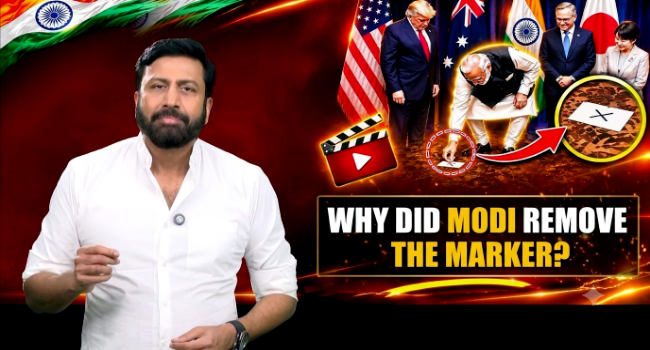
A brief moment just before a group photograph at the Quad summit in Manila has set off a debate in India that has moved well beyond the incident itself. As US President Donald Trump, Australian Prime Minister Anthony Albanese, Japanese Prime Minister Sanae Takaichi and Indian Prime Minister Narendra Modi prepared to pose, Modi bent down, picked up a small card from the floor and put it in his pocket. The clip, lasting only a few seconds, went viral on social media. Questions about what the card was and why Modi took it quickly turned into political arguments over patriotism.
Two competing accounts
Supporters of Modi say the card carried the Indian tricolour. It had been placed to show the leaders where to stand for the group photograph, and Modi picked it up and pocketed it out of respect for the national flag. They cite this as proof of his regard for the Indian flag even on foreign soil, and have praised him for it.
Critics say the card was not the national flag but only a position marker for the photograph. They note that the leaders of the US, Australia and Japan did not pick up and pocket the markers bearing their own countries’ symbols. They ask whether those leaders therefore do not respect their nations, or lack patriotism.
Commentary: points to weigh
The commentary says both arguments raise points worth considering. Modi’s act can be regarded as a sign of patriotism and appreciated as such. But it questions how reasonable it is to doubt other leaders’ love for their countries because they did not do the same. Praising one person’s action does not require belittling another’s, and portraying a small act as an extraordinary political achievement is also an exaggeration.
It argues that the debate reflects the country’s political tendencies more than the video does. Looking for political meaning in every small act by leaders, and praising the actions of those one likes while faulting those of others, is becoming a habit. Political loyalty and passion, rather than facts, are driving the discussion, and the original question is being pushed aside.
What patriotism should be judged by
According to the commentary, patriotism cannot be proved by a video of a few seconds. A leader’s commitment to the nation should be assessed by the decisions taken, the work done in the country’s interest and the responsibility shown towards the people. No yardstick of patriotism can be set by a single act visible before the camera.
It adds that the country has no shortage of issues that need discussion. Unemployment, rising prices, the economic situation, education and healthcare directly affect ordinary people’s lives, and international relations, national security and foreign policy also need deeper debate. It asks what is gained by turning a few seconds of video into a topic discussed all day.
Restraint urged in public debate
The commentary acknowledges that it is natural for social media to bring every incident before the public within moments, and that expressing differing views is not wrong. But casting every issue as a fight between patriots and non-patriots, it says, gives people nothing, and without restraint in debate, important issues get buried.
Some may praise Modi’s action and others may criticise it, it says, but there is no need to tie every small matter to national honour and turn it into an endless controversy. At times, it observes, leaving a small matter as a small matter is also wisdom.
It concludes that the country needs not continuous political fervour but restraint that respects differing opinions, thinking that analyses facts, and a sense of responsibility to focus on issues affecting people’s lives. Discussing how far leaders’ decisions serve the country and its people matters more than seeking political meaning in their every move, it says, because patriotism is to be seen not in a few moments before a camera but in the work done for the country.