





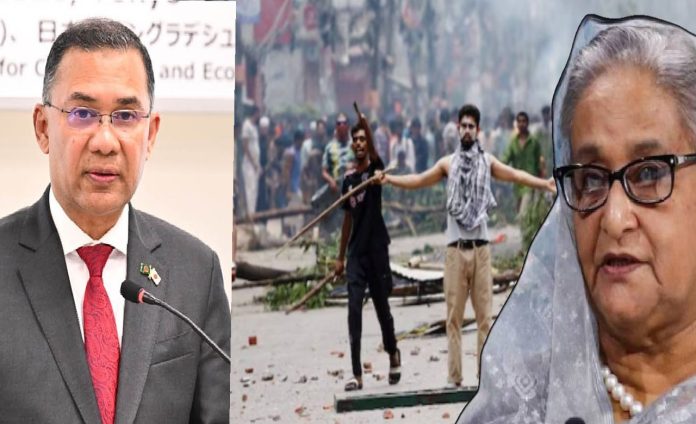
Bangladesh politics have heated up once again. India has reportedly agreed to extradite Sheikh Hasina to Bangladesh on two conditions, and the former prime minister has announced she will return home, setting off political tremors in the country. Awami League workers, who had stayed silent since the government fell in August 2024, have become active again. Hasina has made it clear that she will set foot in Bangladesh in December under any circumstances, and her supporters are taking to the streets to show their strength. This has become a major headache for the government of Prime Minister Tarique Rahman, who is also struggling to set matters right in the country. If the situation continues, whether Rahman will give in to the Awami League is becoming an open question.
Violent Protests In Gopalganj
Protests turned violent in Gopalganj, Hasina’s home district. Hundreds of activists armed with knives and spears took part in the demonstrations and destroyed police barricades. They set fire to an armed police vehicle and an outpost, and destroyed government property and memorials. They also forcibly reopened the party’s district office, which had been shut. Earlier, the burning of offices of the ruling BNP in Tungipara had pushed tension between the two sides to a peak. To bring the situation under control, the government deployed six platoons of Border Guard Bangladesh (BGB) and 1,350 police personnel, and also transferred the district collector and the superintendent of police.
BNP Government Under Pressure
The BNP government led by Prime Minister Tarique Rahman, which came to power with a huge majority in the February 2026 elections, is currently facing severe economic, political and law-and-order crises. The main reasons behind the criticism that the government is failing to meet public expectations are as follows.
Economic crisis and inflation
The government has not been able to revive, at the expected pace, an economy that was shattered after the 2024 uprising. High inflation has increased the burden on ordinary people, leading to strong public resentment. Severe power cuts and gas shortages across the country have pushed many commercial establishments and industries towards closure. Huge non-performing loans piled up in the banking sector, pressure on foreign exchange reserves, and subsidy cuts imposed under IMF conditions have added to public discontent.
Unrest in the garment sector
Lakhs of workers in the garment industry, the backbone of Bangladesh’s economy, have launched protests demanding higher wages. The government failed to keep its promise to set up a new minimum wage board by October, and in the first week of November the protests turned violent. Hundreds of factories shut down, police vehicles were set on fire and highways were blockaded, causing law and order to slip out of control.
Law-and-order failure and extremist threat: Because the police force has not yet been fully strengthened, mob attacks, looting and political reprisal attacks continue in the country. Some individuals with extremist ideologies who were released during the interim government have become active again, and attacks on media organisations have raised questions about the government’s ability to govern. BNP workers themselves coming out on the roads with sticks to obstruct opposition parties has also drawn criticism.
Failure to meet Gen Z expectations: The students and youth who toppled the Hasina government in 2024 are growing impatient that the expected systemic reforms, curbs on corruption and creation of new jobs are not happening. Criticism is being voiced that politics of the old kind is continuing.
Passport Application And Pressure On India
Sheikh Hasina, who is currently sheltering in India, is taking legal steps to return home. Through the London-based law firm Matrix Chambers, she has sent an application to the Bangladesh High Commission seeking a new passport and a National ID (NID) card. Bangladesh’s home minister said authorities are examining whether she is eligible to be issued the documents. Meanwhile, in view of the death sentence handed to her in the country, the Bangladesh government is increasing pressure on India to hand Hasina over under the extradition treaty, saying the legal process has been completed. The Awami League stayed away from the February 2026 elections, in which the BNP came to power. Bangladesh’s future politics now depend on Hasina’s re-entry plan, the death sentence against her and the final decision India takes.