





– Ravi Prakash

France is one of the most beautiful countries in the world. It has the Eiffel Tower in its capital, lovely streets, historic monuments and world-class universities. It is recognized around the globe for the slogan of liberty, equality and fraternity. But what is happening in that same France now?
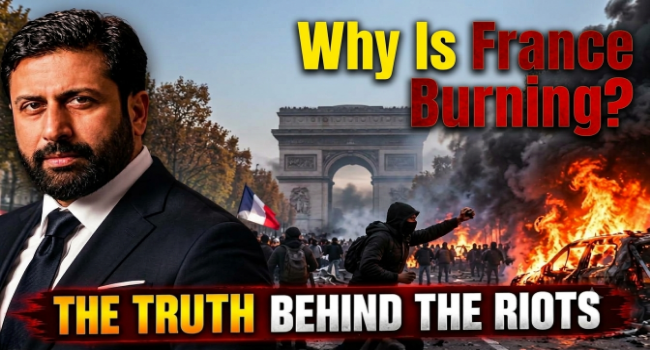
Cars are burning on the roads. Clashes are breaking out between police and protesters. Shops are being destroyed. Lakhs of people are coming out onto the streets against the government.
What Is Really Happening?
Is this merely a students’ movement? Are unemployment, rising prices and the failure of public services the cause? Or is there a bigger crisis behind issues like immigration, national culture and national identity?
On social media, all kinds of claims are doing the rounds. Posts are going viral saying that France is losing its cultural identity, that immigration has changed the country’s demographic makeup, and that the government cannot bring the situation under control. How much of this is true?
This report examines the real reasons behind the protests. How much is the economic crisis to blame? Is there a link between immigration and the violence? Has the Macron government truly lost control?
How It Began: A Student Protest Over Schools
To understand the story, one has to go back to September 2026. Just as the new academic year began, student discontent came out into the open. Students in some schools in the suburbs of Paris, in particular, took to protest. Their main grievances were overcrowded classrooms, a shortage of teachers, a lack of proper facilities in schools, and no access to the resources needed to study.
The protests were at first confined to a few schools but gradually spread to other areas. Students shut the school gates, and teachers and parents stood in support of them. By the first week of October, the movement had grown bigger. In some areas, there were clashes with the police.
One point must be clearly noted. When the movement began, immigration was not the main demand, and it was not a religious dispute. Problems in the education system were the first cause. Later, more issues were added to the protests, and that is where the story took another turn.
Economic Anger Merges With the Movement
Economic and political discontent in France did not begin just now. People have long been dissatisfied over rising prices, wages, pensions and the quality of public services. By October 17, the protests included trade unions, political activists, and those who had supported the Yellow Vest movement in the past, in addition to students.
The Yellow Vest movement of 2018 began as a protest against rising fuel costs. It later became a major protest against economic inequality and government policies. Questions were raised then about whether the economic burden was being placed on ordinary people alone, and whether the government was paying attention to the problems of the poor. The same kind of discontent can be seen now. Workers are demanding better wages. Families are struggling with rising costs. Students are asking for better schools.
The government, for its part, has financial constraints. According to INSEE, France’s official statistics agency, the deficit stood at 5.1 percent of GDP in 2025. Debt has crossed 115 percent of GDP. These figures cannot be called the sole cause of the current protests, but they show the financial pressure the government is under.
When economic hardship, dissatisfaction with public services and declining trust in political leadership all come together at once, even a small movement can turn into a major political crisis. This factor is key to the developments now unfolding in France.
Violence on the Streets, and Questions for the Police
Cars burning on the roads, shops destroyed and clashes with the police are appearing widely on social media. These incidents cannot be downplayed. On October 17, reports emerged of arson, looting and clashes with the police in Paris and several other French cities. Hundreds of people were detained.
French Prime Minister Sébastien Lecornu warned that urban violence was growing in the protests. The government made it clear that it would take action against those who endanger lives and damage public property.
There is, however, an important distinction. It is wrong to assume that everyone who took part in the protests is committing violence. A student who took to the streets for better education is one person. A person who sets a car on fire is another. The two cannot be lumped together.
At the same time, questions have been raised about the actions of the police. News reports said that some young people who took part in the protests were seriously injured, and that concerns had been expressed about the force used by the police. Both matters need to be investigated. Action must be taken against those who committed violence. If there are allegations that the police used excessive force, they too must be examined. In a democracy, upholding the right to peaceful protest is just as important as maintaining law and order.
The Immigration Claim: What the Data Says
The most controversial issue in this story is immigration. One claim is being made forcefully on social media: that France is losing its culture because of immigration, that the country’s demographic makeup has changed, and that this is the main reason for the violence now taking place.
According to INSEE, around 11.6 percent of France’s population in 2025 were immigrants. That means nearly 80 lakh people were born abroad and live in France. About a third of them have also acquired French citizenship. These figures indicate the level of immigration in France. They do not prove that immigration is the cause of the current protests and violence.
Debate over immigration, religious identity, secularism, discrimination and integration into society has been going on in France for a long time. In some areas, there are also unemployment, poverty, housing problems and inequalities in education. All of these are real problems and should be examined.
But one cannot determine a person’s nationality, religion or reason for committing violence by looking at their appearance. Likewise, it is not right to say that a person born and raised in France is not a French citizen because their parents came from another country. There can be debate on immigration policies, and questions can be asked about their effects. But evidence is needed to hold an entire community responsible for violence.
So the real question is this: is immigration an important issue in political debate in France? Yes. Is immigration the sole cause of the violence now taking place? No. There is a big difference between these two statements.
The Economic Claim: Is Immigration Behind France’s Debt?
Another claim is appearing on social media. Some say that France has been weakened economically by spending money on immigrants for decades, and that the government is now in complete trouble.
It is true that France has problems such as government debt and a budget deficit. But there is no solid evidence to say that immigration alone is the cause of the economic problems. Many factors affect the government’s financial position, including spending on pensions, health services, salaries of government employees, tax revenue, economic growth and interest on debt. Immigration may also have economic effects, but they are not the same for everyone. One has to look at factors such as a person’s age, education, employment, income and the taxes they pay.
Anyone who claims that immigration alone is the cause of France’s economic problems must present the economic data to support it. How much was spent? How much tax revenue came in? How much was the effect of other economic problems? Pointing to a single cause without answers to these questions is not sound analysis.
Macron’s Test and the Question of Control
This is a very critical time politically for President Emmanuel Macron. Political division in the country has deepened. There is dissatisfaction with economic policies, and anger among the people over public services. The protests have now become another challenge.
With the 2027 presidential election approaching, various political parties are interpreting these developments from their own perspectives. The government says it will curb the violence and take action against those who break the law. The opposition parties portray the crisis as a failure of government policies.
Can it be said that violence has occurred in some areas and that the French government has completely lost control? That cannot be concluded. The police are taking action, arrests are being made, investigations are continuing and government institutions are functioning.
The real challenges before the government lie elsewhere. Can it reduce the discontent among the people? Can it resolve the problems in schools? Can it improve public services? Can it ensure police accountability while maintaining law and order? What matters for a government is not only how many police officers it has deployed on the roads. It also matters whether it can understand why people are protesting and offer solutions to those problems.
What It Means for India
France is an important strategic partner for India. There is cooperation between the two countries in many fields, including defence, space, technology, trade and education. In February 2026, India–France relations were upgraded to the level of a Special Global Strategic Partnership. If political instability develops in France, it is therefore a matter of importance to India as well.
It cannot be said, however, that every protest in France poses a danger to Indians. The conditions faced by Indian students studying there, Indians living there and those travelling there may be affected locally. Official information such as security advisories, the status of flights and announcements from universities should be checked.
There is another big question. In India too, debates continue over education, jobs, prices, social identity and police action. The developments in France remind us of one thing: to understand people’s discontent, we must examine the real problems. Those who commit violence must be held accountable. At the same time, the whole of society should not be viewed through a single lens. Blaming one community for complex problems is just as dangerous as ignoring real problems.
The Whole Story at a Glance
Students first began protesting, demanding proper facilities in schools. Dissatisfaction over wages, pensions, rising prices and public services then merged into the movement. In some areas, the protests turned violent, with arson, looting and clashes with the police. The government said it would take action against those who committed violence, while questions were also raised about the force used by the police. At the same time, the political debate on immigration, national culture and national identity grew hotter.
There may be real problems in France over immigration and integration into society. But the evidence currently available is not sufficient to say that immigration alone is the cause of the violence, that France has completely lost control, or that the country’s population is being deliberately changed.
France is facing a serious social and political crisis. To understand its causes, one must look at everything: the education system, economic conditions, political division, public services and law and order.
If students say their schools lack proper facilities, if workers say their wages are not enough to meet their expenses, and if people lose trust in the government, can those problems be solved merely by deploying more police on the roads? On the other hand, if violence takes place in the name of protest, can destroying public property provide a solution?
France is now facing tough questions about its economic condition, its government institutions, its social unity and its future. These problems must be addressed honestly. Violence must not be justified. People’s discontent must not be ignored. Allegations without evidence must not be spread as facts.
A country’s future is not decided by cars burning on the roads. It will be decided by the government’s ability to solve problems, a system that respects the law, the protection given to people’s rights, and policies that sustain trust in society.
That is the real story behind the crisis unfolding in France.