





- Ravi Prakash
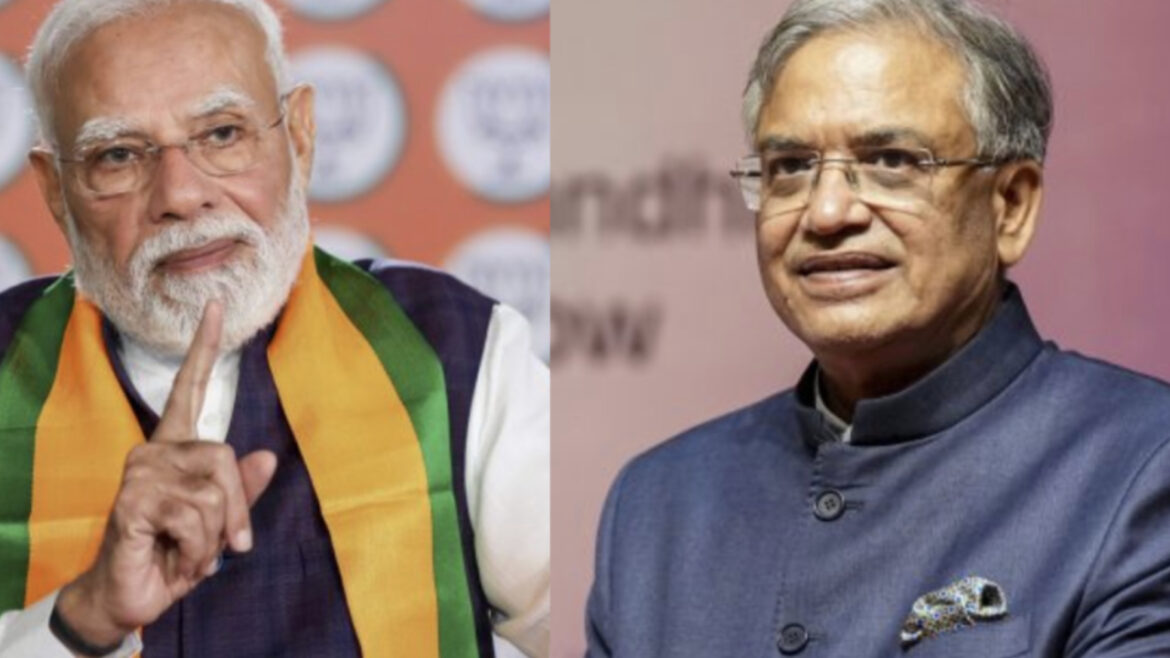
New Delhi: A serious question is now at the centre of national politics. Chief Election Commissioner Gyanesh Kumar is facing grave allegations, but this time they come from an unexpected quarter: R.K. Singh, a former Union Home Secretary, former Union Minister and former BJP MP. Singh has written an open letter to Kumar raising serious questions about the process being carried out in the name of the Special Revision of the electoral rolls. He has gone beyond demanding the Chief Election Commissioner’s resignation and has also called for criminal cases against him.
The letter asks what the legal validity of the revision is, why crores of voters’ names were removed, and who removed them. It asks who filed the appeals in the case of 16 lakh voters in West Bengal, who controls the Election Commission of India’s digital system, and who is making decisions in a Commission that is supposed to function with three commissioners. The Supreme Court has agreed to hear the entire matter next week. The question now being asked is whether this is truly an attack on Gyanesh Kumar, or whether the real target is Modi.
Why R.K. Singh’s Letter Has Caused a Sensation
Singh is not an ordinary opposition leader. He is a former Union Home Secretary who served as a Union Minister in the Modi government and was a BJP MP from 2014 to 2024. He now alleges that the law was violated in the Special Revision of the electoral rolls. In his view, removal from office alone is not enough, and the matter should move towards criminal proceedings. In the letter, he also suggested that opposition parties consider boycotting elections if such a situation arises.
It must be stated clearly that these are allegations made by R.K. Singh and not facts established by a court. The Election Commission of India has also rejected them. The country therefore has two versions before it: Singh’s allegations on one side and the Commission’s explanation on the other, with the Supreme Court hearing in the middle.
The 13 Crore Figure and What It Means
The number most often cited in the controversy is 13 crore. During the Special Revision, crores of names across the country were removed from the draft electoral rolls. This does not mean that 13 crore people have permanently lost their right to vote. These are names removed from the draft rolls, and after objections, claims and verification, they can be added back.
The central issue, therefore, is not the number alone. It is why those names were removed, how they were verified, who verified them, and how a person whose name was wrongly removed can be registered as a voter again. Having one’s name on the electoral roll is the first step towards voting in an election.
The Form-6 Dispute
A second major controversy concerns Form-6, used to register as a new voter. Reports say a new declaration was added to the online Form-6 during the Special Revision, asking whether the applicant’s name, or the names of their parents and grandparents, appear in the old electoral roll. Two Election Commissioners are reported to have raised objections at this point.
The question being asked is how an 18- or 19-year-old registering as a new voter today could have been on the roll 20 years ago, and what such a person should do if their parents’ names are not in the old list. The Election Commission maintains that the declaration is legal and falls within matters the Supreme Court has examined earlier. Here too, an allegation on one side is met by the Commission’s explanation on the other, with the court’s decision awaited.
The West Bengal Appeals
West Bengal saw a major dispute over the addition of nearly 16 lakh voters. Reports say that after claims and hearings, election officials recognised some voters’ names as valid, but appeals were then filed against those decisions. According to reports, one Election Commissioner asked who permitted the appeals, on whose orders they were filed, and who took the decision on behalf of the Commission.
This is not only about 16 lakh voters. The real question is who has the power to make decisions in the Election Commission, and that is the most crucial point in the entire story.
Who Decides Within the Commission?
The Election Commission does not consist of the Chief Election Commissioner alone. It currently has three commissioners: Gyanesh Kumar, Sukhbir Singh Sandhu and Vivek Joshi. According to reports, the two Election Commissioners have raised objections on several issues over the past few months. An Indian Express report put the total at 14 objections, covering key electoral roll decisions: the Special Revision, addition and removal of voters, Form-6, ECINET and the West Bengal appeals.
This raises the question of whether the Chief Election Commissioner alone makes decisions, or whether all three commissioners must decide together. The same question is now before the Supreme Court. The Commission’s position is different: it says internal discussions and differences of opinion are natural, but that the final Special Revision decisions were approved unanimously. The opposition alleges that Kumar acted unilaterally, while the Commission insists the final decisions were unanimous. Which version is correct is what the court must now examine.
ECINET and Control of the Electoral Roll
Another name that ordinary voters barely know features in the story: ECINET, the digital election system used by the Election Commission. Key questions have been raised here as well. Does the decision-making power the law gives to field-level Electoral Registration Officers also exist within the digital system, or are their decisions being limited by software rules?
This matters because whether to add or remove a name, and whose name is valid, all ultimately pass through a digital system. That raises the question of who sets the rules in that system and who controls it. It is not merely a technical question but one about control over the electoral roll.
The Goa Case and the Commission’s Corrective Steps
The Goa case has emerged as an example. It came to light that 97 voters, whom local officials had verified as eligible, did not make it into the final list, and allegations were made that problems in the digital system were responsible. The Election Commission says it has taken corrective steps, that the affected voters can apply again through Form-6, and that a special drive has been undertaken. It would therefore be wrong to say that 97 people have permanently lost their right to vote. One question remains, however: if an Electoral Registration Officer decides a person is eligible but the software cannot implement that decision, who is responsible?
On September 26, the Commission announced several new measures. Booth Level Officers are to go further into the field, and special help centres and camps are to be set up for the poor, workers and homeless citizens. Deadlines for claims and objections have been extended in some places. A committee has been formed to review ECINET, which the Commission says will include an independent IIT or IIIT expert, and it has also decided to review information technology initiatives more thoroughly in future. These are all improvement measures announced by the Commission. Yet a question inevitably arises: if everything was in order, why did these changes become urgently necessary now?
The Supreme Court Hearing
This is what makes the story more consequential. Next week, the Supreme Court will hear challenges to Gyanesh Kumar’s style of functioning and to the Special Revision of the electoral rolls being carried out across the country. A major allegation in the petition is that powers vested collectively in the Election Commission were exercised in some decisions without the consent of the other two commissioners. There are also petitions seeking an independent or forensic examination of ECINET and ERONET.
All of these remain allegations and legal challenges for now, and the court has not given a final decision. The most important word in this story is therefore “question,” not “final conclusion.”
Where Does Modi Come In?
The central question in the headline is how Modi enters this controversy, and whether this is truly an attack on Gyanesh Kumar or on Modi as well. Caution is needed here. At present, there is no evidence to say that every decision Kumar took was on Modi’s orders. R.K. Singh’s letter, however, raises the question of whether Kumar is working on the orders of his superiors. That is Singh’s allegation, and it currently has no confirmation from a court.
Politically, the question arises because the Election Commission is the institution that conducts the country’s elections. Any major controversy over its independence naturally brings political questions to the government as well. The debate may therefore remain confined to Gyanesh Kumar, or it may move towards political accountability behind the entire system.
The Bigger Picture
Setting the whole matter aside for a moment, this is not Congress versus BJP, and it is not the opposition versus the government. It is not even R.K. Singh versus Gyanesh Kumar. At the centre is a single institution, the Election Commission of India. It decides who will be on the electoral roll, whose name will not be there, whose name will be removed, whose name will be added back, and how elections are conducted. The people’s trust in the country rests on this system.
The questions are therefore simple. Were the Special Revision decisions truly taken collectively? Were voters’ names removed only after proper verification? Were the changes to Form-6 made in the proper manner? Who permitted the appeals over the 16 lakh voters in West Bengal? Has ECINET placed any limits on the powers of field-level officers? Why did two Election Commissioners raise objections 14 times?
The biggest question is whether the Election Commission is run by the Chief Election Commissioner alone or by the three commissioners together. That is the real fight now. This is therefore not merely the biggest attack on Gyanesh Kumar and is not about one individual alone. It concerns how the Election Commission functions, who makes decisions, who controls the electoral roll, and who is ultimately accountable for those decisions.
Finally, one question remains: is this truly an attack on the Chief Election Commissioner, or the beginning of a much bigger political fight involving the Modi government? The answer need not come from politicians. It has to come from the courts, and the people of the country must also watch the entire matter carefully.