





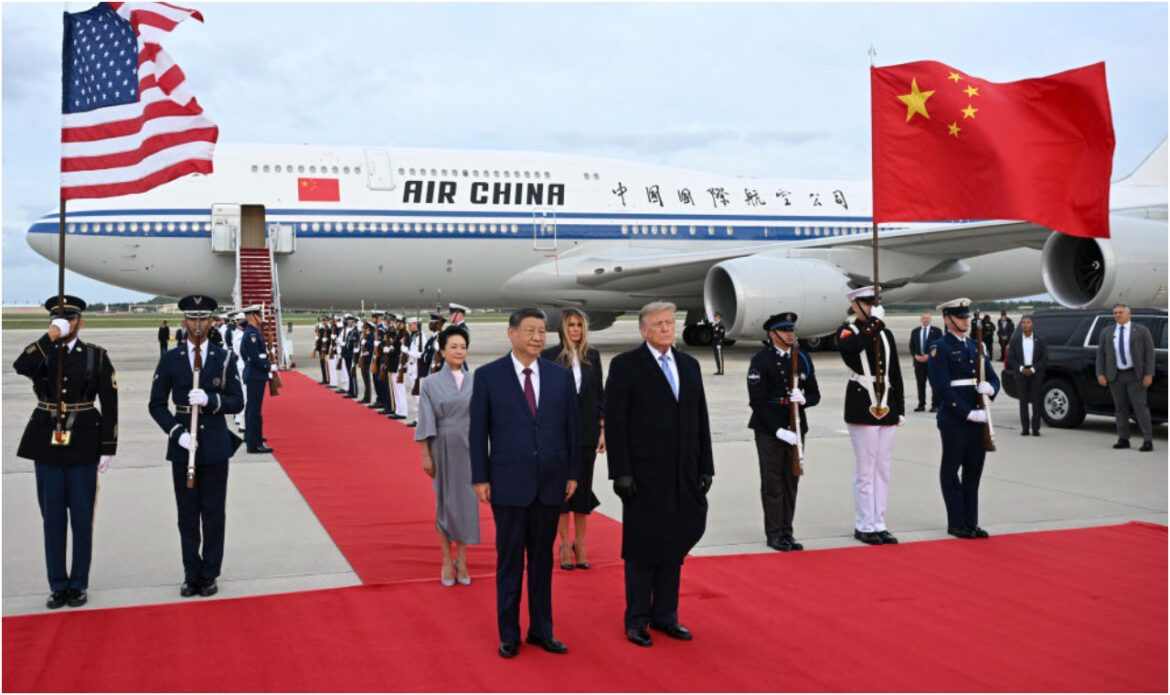
Chinese President Xi Jinping arrived in the United States on a state visit accompanied by his wife, Peng Liyuan, marking his first such trip in a decade. In a notable departure from customary protocol, under which visiting foreign leaders are typically received at the White House, President Donald Trump personally traveled to Joint Base Andrews with First Lady Melania Trump to greet Xi upon arrival, a gesture that drew widespread attention given the current strain in bilateral relations over trade, artificial intelligence, Iran, and Taiwan.
The three-day visit will include a formal welcome ceremony for Xi at the White House, where he and Trump are expected to hold high-stakes one-on-one talks addressing bilateral relations and pressing international disputes. The two leaders are also scheduled to jointly visit the National Archives. Trump additionally showcased a newly constructed helipad on the White House grounds, describing it as one of the most beautiful in the world and expressing pleasure that Xi would be landing there.
✨🇨🇳President Xi Jinping said:
China and the United States should be partners, not rivals. Achieving the great rejuvenation of the Chinese nation and making America great again can go hand in hand, and the two countries can contribute to each other's success, thereby benefiting… pic.twitter.com/0asZBdOzKw
— 🇨🇳XuZhenqing徐祯卿 (@XueJia24682) September 24, 2026
As a further gesture of goodwill, Trump is set to host a large state dinner at the White House on the evening of the visit. The guest list is expected to include prominent figures from the global technology and business sectors, among them Nvidia CEO Jensen Huang and Tesla, SpaceX and X chief Elon Musk, alongside leading names from banking and corporate America. Trump remarked that the event would draw much of the world’s tech leadership, joking that there were not enough seats to accommodate everyone who wanted to attend.
The warm reception extended to Xi has, however, triggered sharp political backlash within the United States. Senate Armed Services Committee Chairman Roger Wicker criticized the invitation, arguing that China’s extensive military build-up and continued support for Iran should have precluded such a welcome. He further suggested, pointedly, that Trump ought to use the dinner as an opportunity to confront these issues directly with Xi rather than treat the occasion purely as a diplomatic courtesy.
Secretary of State Marco Rubio, meanwhile, defended the administration’s approach, asserting that high-level engagement between the world’s two largest economies and most significant military powers remains essential to preserving global stability. The contrasting reactions underscore the delicate balance Washington is attempting to strike between maintaining diplomatic channels with Beijing and addressing longstanding security and strategic concerns that continue to define the US-China relationship.