





- Ravi Prakash

If the government commits a wrong, who bears the cost of that wrong? An extraordinary development has emerged from the country’s judicial system. The Allahabad High Court has ordered that five lakh rupees be paid in compensation to a young protester who was detained for nearly five months under the National Security Act (NSA). Notably, the court did not direct that this compensation come from the government treasury — instead, it ordered that the amount be recovered from the personal salaries of the officials found responsible. Among those who had ordered her detention was the district collector.
The case has drawn national attention largely because of who that district magistrate is: Medha Roopam, daughter of India’s Chief Election Commissioner, Gyanesh Kumar, who heads the country’s entire electoral system. Roopam is herself an IAS officer, and the High Court has now ordered that the compensation be recovered directly from her salary.
However, observers note that the significance of this case extends far beyond the identity of the official involved. At its core, the ruling raises a fundamental question: what are the limits of the authority granted to a government official, and what happens when that authority is used to deprive a citizen of their liberty, only for a court to later determine it was misused? Can such actions simply be set aside and forgotten, or must there be accountability?
Background of the Case
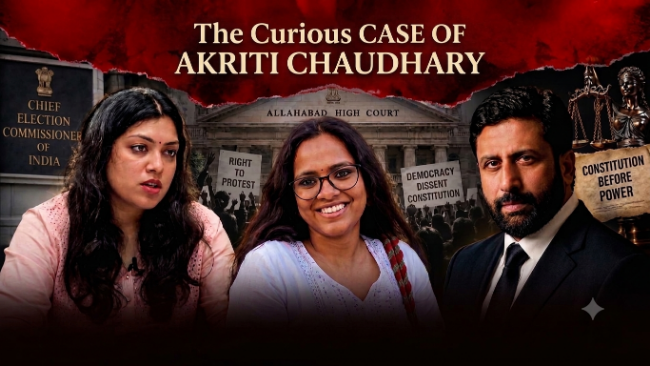
The protester at the centre of the case, Akriti Chaudhary, was detained under the NSA for nearly five months. The government alleged she was linked to violence that broke out during protests by workers in Noida. However, when the High Court sought evidence to support the allegations, it found none of substance — no video evidence of her inciting violence, no message calling for unrest, and no credible material showing she had urged people to throw stones or set vehicles on fire. The government was unable to present evidence sufficient to substantiate its claims.
As a result, the High Court quashed the NSA detention order. In what has been described as the most extraordinary aspect of the ruling, the court went further, ordering that the five-lakh-rupee compensation be recovered not from public funds but from the personal salaries of the responsible officials, and directed that the matter be recorded in their official service records.
Court’s Broader Observations
In its judgment, the court did not merely order Chaudhary’s release. It scrutinized how and why the government exercised its authority, and whether there was any legitimate basis for doing so. Reviewing the material submitted by the state, the court found it to be based largely on assumption and speculation, repetitive in nature, and lacking any credible evidence. It noted that authorities had alleged Chaudhary incited rioting, encouraged the burning of vehicles, and provoked stone-throwing — yet could produce no video, message, or credible material substantiating any of these claims.
More strikingly, the court observed that the district magistrate appeared to have acted with the intent of making an example of a young student activist, apparently to deter others from protesting or speaking out. The court underscored that the Constitution grants the government substantial powers, but that such power comes paired with responsibility. It further reminded officials that their loyalty is owed not to the political executive but to the Constitution, stating plainly that officials are public servants, not rulers, and that citizens are not subjects to be governed but people the government is meant to serve.
The court went on to warn that if such authoritarian conduct by officials were to continue unchecked, Uttar Pradesh risked drifting toward authoritarian governance. Legal observers have noted that this was not a political allegation from any party or opposition figure, but a formal caution issued by the judiciary itself regarding the potential consequences of unchecked state power.
Wider Implications
Commentators say the ruling carries significance well beyond this individual case or the state of Uttar Pradesh. They point out that if the price for supporting workers, farmers, or a cause — or simply questioning a government decision — becomes imprisonment, it sends a troubling signal for democratic society. This, they argue, raises a critical question: at what point does a government’s duty to maintain law and order shift into the suppression of dissent, and where should that line be drawn?
Central to the court’s reasoning was a clear distinction: the government is obligated to maintain law and order, and law enforcement action is warranted against those who genuinely engage in violence. However, peaceful protest itself must never be criminalized, as the Constitution guarantees freedom of speech and expression, the right to public assembly, and the right of citizens to voice dissent. The court described peaceful protest as functioning as a “safety valve” for society, and noted that democracy is not tested when citizens agree with their government, but rather when they disagree with it.
Legal analysts have framed the case as a broader reminder that citizens are not powerless before the state — that constitutional protections and judicial oversight exist precisely for such situations, and that the irresponsible exercise of official power must carry consequences.
The five months Chaudhary spent in detention cannot be restored, and the compensation awarded cannot undo that loss. However, legal commentators suggest that if the ruling prompts officials to exercise greater caution before curtailing a citizen’s liberty in future, it will have served a meaningful purpose beyond the individual case. As one commentator put it, the central question raised by the case is not about identifying the government of the day, but about who protects a citizen when the government itself is found to be in error — a question this verdict may serve as a starting point in addressing, reaffirming that in a constitutional democracy, authority must have limits, responsibility must carry accountability, and the Constitution must always remain paramount over the government itself.