





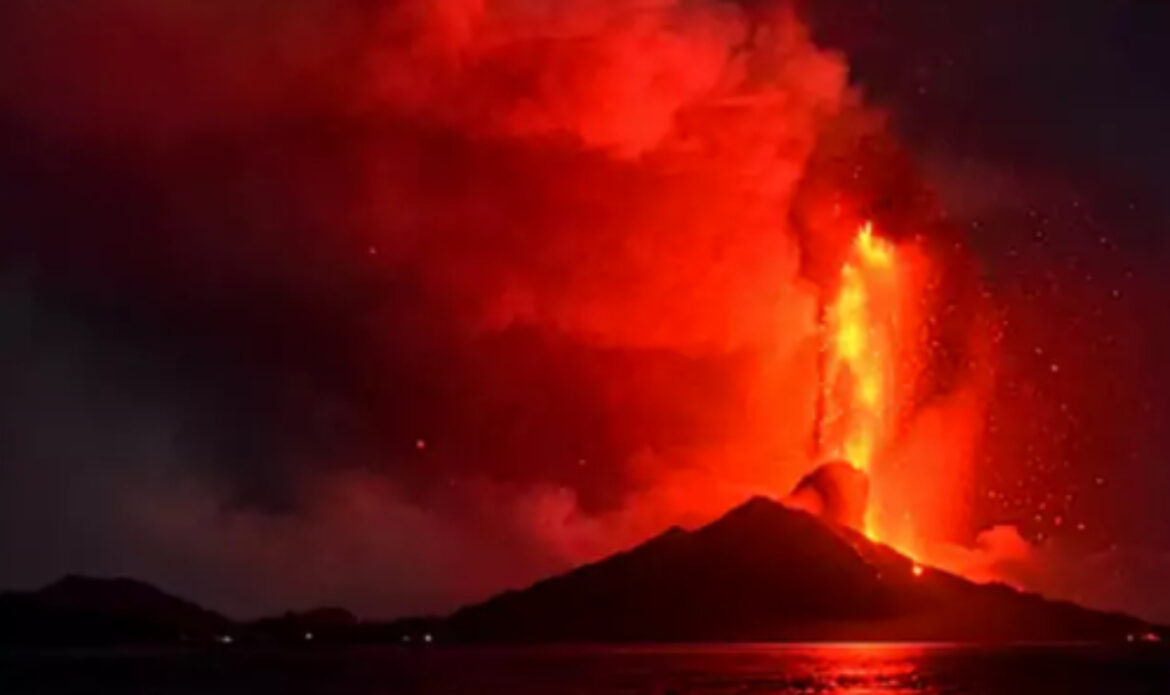
Indonesia’s Anak Krakatau volcano erupted violently, sending lava, thick black ash and smoke nearly 50,000 feet into the sky. The dense ash cloud blanketed the atmosphere, plunging surrounding areas into darkness even during daytime and creating a frightening scene. Minor tremors that began on the volcano from Friday escalated into a full-scale eruption by Sunday.
The thick ash emitted from the volcano completely covered nearby villages and surrounding areas, blanketing homes, roads and trees in ash. However, officials from the Volcanology and Geological Hazard Mitigation agency, having anticipated the severity of the situation in advance, swiftly moved to alert authorities and evacuate local residents to safe areas, ensuring no loss of life occurred. Mountaineering expeditions and tourist visits to the region were also completely suspended as a precaution.
The eruption’s impact extended beyond local residents to domestic and international air travellers. Ash clouds from the volcano rose thousands of feet into the sky, posing an extremely dangerous risk to aircraft, since fine rock particles within these ash clouds could enter aircraft engines and cause them to stall if planes flew through them. Taking this into account, Indonesian civil aviation authorities took a swift and critical decision, urgently cancelling flight services operating from Soekarno-Hatta International Airport near Jakarta. This sudden decision severely disrupted around 209 flight services, leaving over 22,800 passengers stranded at the airport for hours.
The volcano is situated in the Sunda Strait, between the islands of Java and Sumatra in Indonesia. In the local Indonesian language, “Anak Krakatau” translates to “Child of Krakatoa.” The original Krakatoa mountain, whose 1883 eruption is remembered as one of history’s most catastrophic volcanic events, produced an explosion sound heard thousands of kilometres away worldwide and triggered massive tsunamis that killed thousands of people, with the old mountain sinking completely into the sea during that eruption. This new volcanic island then emerged from the seabed at exactly the same location in 1927, and has continued growing ever since, frequently spewing lava as it has done now.
Geographically, Indonesia’s location within the highly hazardous “Pacific Ring of Fire” is the primary reason behind such repeated eruptions. Massive tectonic plates beneath the Earth’s surface here are in constant collision, particularly the friction between the Indo-Australian Plate and the Eurasian Plate, which generates extreme underground heat and magma. When gas pressure building up alongside this magma reaches extreme levels, volcanoes erupt violently to release that pressure — precisely what occurred in the case of Anak Krakatau.